
"Webb Space Telescope's Groundbreaking Discoveries: Ancient Quasars, Cosmic Web, and Complex Organic Molecules"
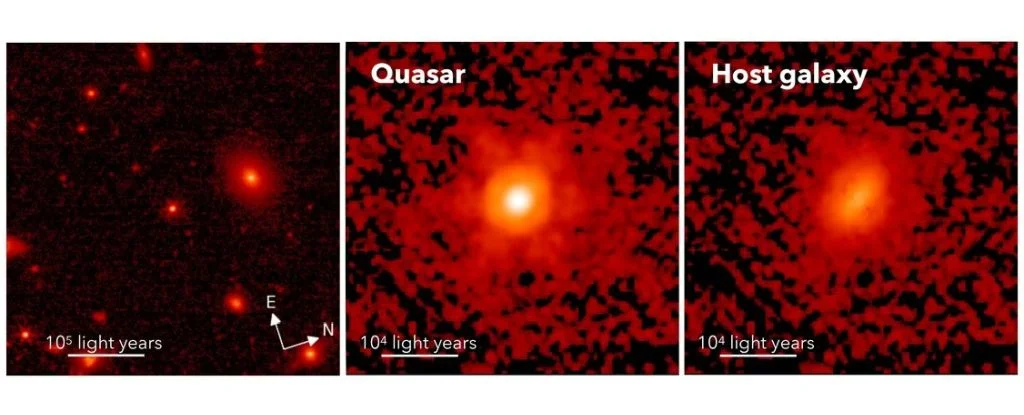
For the first time, astronomers have detected starlight in galaxies hosting quasars, active supermassive black holes, during the early Universe. Using data from the Subaru Telescope and the James Webb Space Telescope, researchers were able to study two quasar galaxies approximately 860 million years after the Big Bang. By subtracting the light emitted by the quasars, they were able to observe the starlight from the host galaxies and calculate their masses. The findings suggest a link between the masses of supermassive black holes and their galaxies, providing insights into the formation and growth of these objects during the Cosmic Dawn. Further observations with the James Webb Space Telescope are planned to expand the sample size and improve our understanding of early Universe evolution.
- For The First Time, Starlight From Quasar Galaxies Has Been Detected at The Dawn of The Universe ScienceAlert
- James Webb Space Telescope sees 1st starlight from ancient quasars in groundbreaking discovery Space.com
- Webb identifies the earliest strands of the cosmic web Phys.org
- 860 Million-Year-Old Quasar Had Already Amassed 1.4 Billion Times the Mass of the Sun Universe Today
- Webb Space Telescope Discovers Complex Organic Molecules in Galaxy More Than 12 Billion Light-Years Away SciTechDaily
Reading Insights
0
9
4 min
vs 5 min read
86%
888 → 123 words
Want the full story? Read the original article
Read on ScienceAlert