
Webb Telescope Spots One of the Earliest Galaxies, Tracing the First Stars
TL;DR
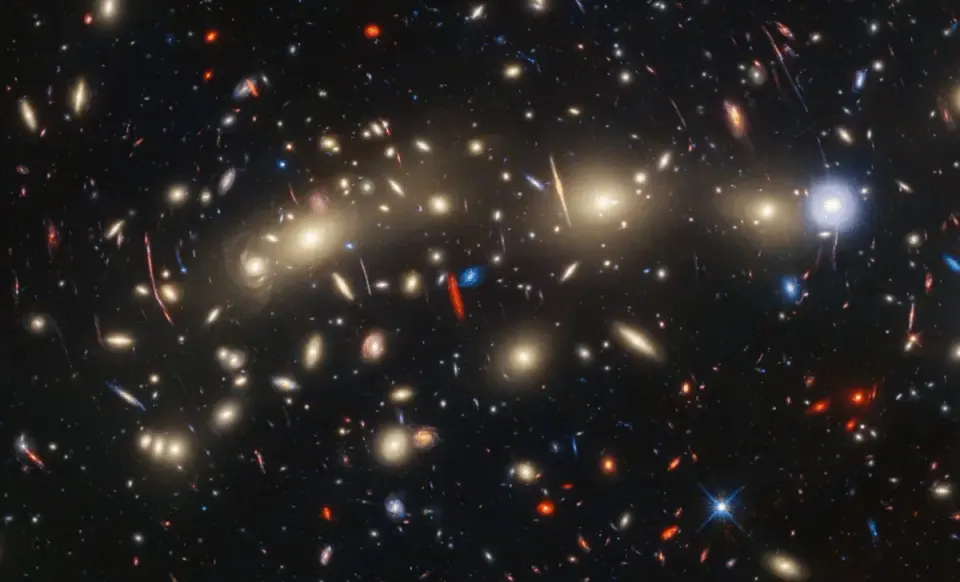
Using the James Webb Space Telescope, astronomers captured LAP1-B, one of the universe’s earliest and faint galaxies, dating to about 13 billion years ago (roughly 800 million years after the Big Bang). Gravitational lensing by a foreground cluster amplified its light ~100x, enabling spectroscopy that reveals extremely low metal content and signatures of Population III stars, including a high carbon-to-oxygen ratio. The data also suggest the galaxy sits in a massive dark matter halo, offering critical clues about how the first galaxies formed and evolved in the early cosmos (Nature).
Topics:scienceastronomy#astronomy#dark-matter#gravitational-lensing#jwst#lap1-b#population-iii-stars
- Webb Telescope Captures Glimpse Of Universe’s First Galaxies The Daily Galaxy
- Astronomers just came one step closer to seeing the universe’s first stars Scientific American
- Webb discovers one of the universe's first galaxies Phys.org
- Did Scientists Just Find the First Stars? A Troubling Cosmic Clue Emerges Futura, le média qui explore le monde
- An ultra-faint, chemically primitive galaxy forming in the reionization era Nature
Want the full story? Read the original reporting
Read on The Daily Galaxy