
Pulsar Timing Arrays Set First Gravitational-Wave Limits on Early Black Hole Binaries
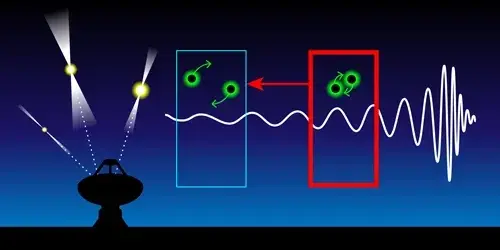
A new study by Yiqin Chen and colleagues uses the Parkes Pulsar Timing Array to establish the first direct gravitational-wave limits on supermassive black hole binaries in the early universe. By correcting for a 'redshift bias' that makes distant sources appear brighter in nanohertz frequencies, the team extended sensitivity to redshifts up to 20. Although current data cannot detect specific early binaries, the limits come within a factor of two of the mass of a known quasar at redshift 6.3, offering a new method to probe black hole growth during the cosmic dawn.
Key points
- Yiqin Chen and the Parkes Pulsar Timing Array collaboration published a study in Physical Review Letters setting the first direct gravitational-wave constraints on supermassive black hole binaries at high redshifts.
- The research utilizes a cosmological correction for 'redshift bias,' which increases the apparent brightness of distant binary sources in the nanohertz frequency range, extending sensitivity to redshifts up to 20.
- The study targets the 'cosmic dawn' era, approximately 500 million years after the Big Bang, where the James Webb Space Telescope has observed luminous 'little red dots' that may indicate massive early black holes.
- Current observations are not yet sensitive enough to detect individual binaries from this era, but the limits are within a factor of two of the estimated mass of the quasar J0100 + 2802 at redshift 6.3.
- Future instruments like the Square Kilometer Array and Deep Synoptic Array are expected to improve pulsar timing precision, potentially allowing the detection of individual early-universe black hole binaries.
Background
This development follows recent debates regarding the rapid growth of supermassive black holes in the early universe. Earlier coverage highlighted that James Webb Space Telescope observations of 'little red dots' at redshifts around 10 suggest black holes reached masses of 100 million solar masses within 500 million years of the Big Bang. These findings challenge standard models of black hole formation, prompting researchers to explore whether these objects started massive or grew rapidly through mergers and accretion. The current study provides a gravitational-wave perspective to test these electromagnetic observations.
Why it matters
This research bridges electromagnetic and gravitational-wave astronomy to address a fundamental puzzle: how supermassive black holes achieved their size so quickly in the early universe. By demonstrating that pulsar timing arrays can probe high-redshift binaries, the study offers a new tool to test theories of black hole seed formation and growth, potentially resolving the tension between observed early black hole masses and standard accretion models.
What to watch
The next step involves combining data from multiple pulsar timing array collaborations to increase sensitivity. Additionally, the deployment of next-generation instruments like the Square Kilometer Array and Deep Synoptic Array aims to improve the precision of pulsar timing measurements, which could eventually allow the detection of individual supermassive black hole binaries from the cosmic dawn era.
Want the full story? Read the original reporting
Read on American Physical Society