Tag

Cosmic Dawn

All articles tagged with #cosmic dawn

JWST Spots Crowded Galaxy Merger at Cosmic Dawn Enriching Surrounding Gas
space12 hours ago

JWST Spots Crowded Galaxy Merger at Cosmic Dawn Enriching Surrounding Gas

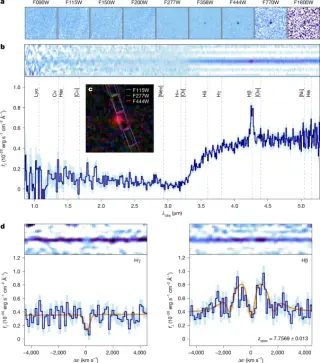
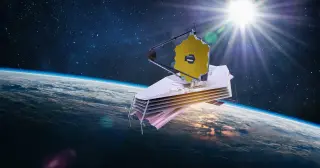
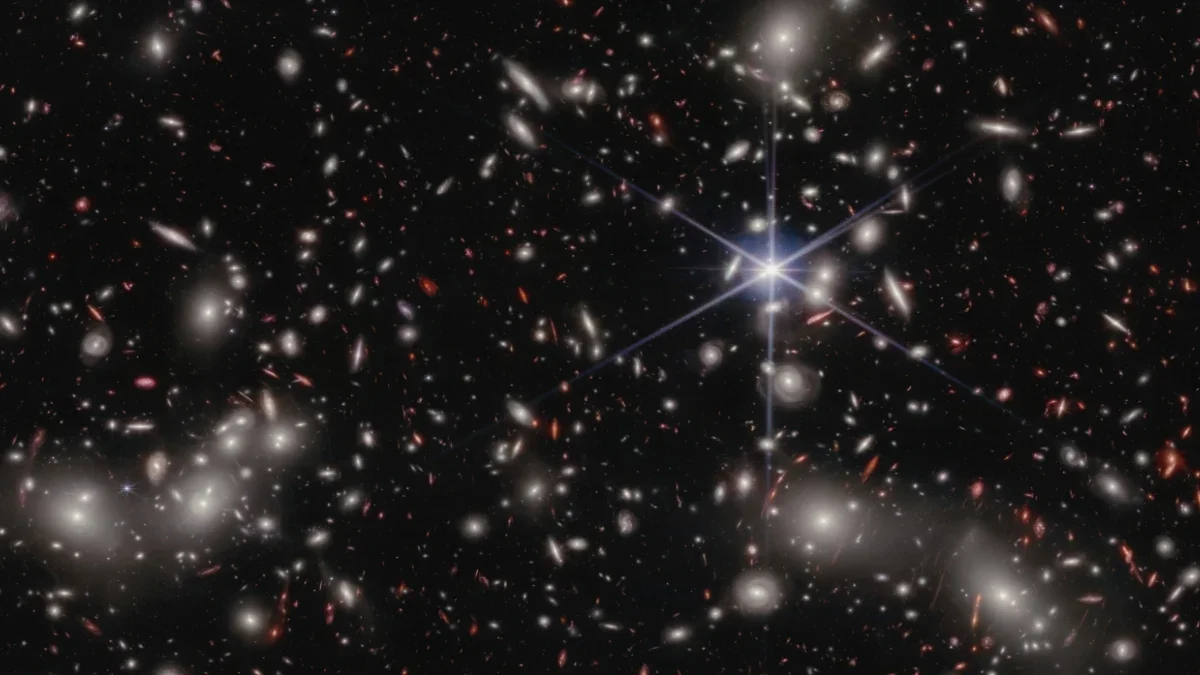
JWST has imaged JWST’s Quintet, a merger of at least five galaxies at redshift ~6.7 (about 800 million years after the Big Bang), revealing a compact, clumpy system with ~17 galaxy-sized clumps, a combined star-formation rate around 255 solar masses per year, and a halo of oxygen-emitting gas (O III) and Hβ linking the galaxies. The presence of metal-enriched gas around the system shows heavy elements were already dispersed into the surrounding medium by intense interactions, implying the early universe was chemically mature and dynamically complex far earlier than some models predict and potentially related to the emergence of massive, quiescent galaxies later on.

Ancient Flickering Quasar Reveals Early Growth of Supermassive Black Holes
space29 days ago

Ancient Flickering Quasar Reveals Early Growth of Supermassive Black Holes

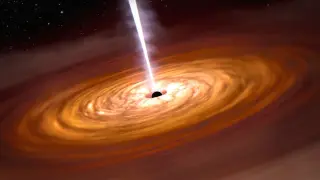
Astronomers report the discovery of J0439+1634, the oldest known flickering quasar, whose light has traveled more than 13 billion years to Earth, dating to the cosmic dawn when the Universe was about 850 million years old. The quasar appears to host a pancake-shaped, surprisingly mature accretion disk feeding a supermassive black hole over 600 million solar masses, making it extremely bright. Multi-wavelength data, including NEOWISE infrared observations, show irregular flickering driven by variable gas inflow, providing direct clues about early black hole growth and enabling new mass-measurement approaches. The study suggests growth processes seen in nearby quasars were already in place early on, and future facilities like the Vera C. Rubin Observatory and the Nancy Grace Roman Space Telescope will hunt for even earlier examples.

Webb’s Early Galaxies Are Brighter and Earlier Than Expected, Rewriting Star-Formation Timelines
space1 month ago

Webb’s Early Galaxies Are Brighter and Earlier Than Expected, Rewriting Star-Formation Timelines

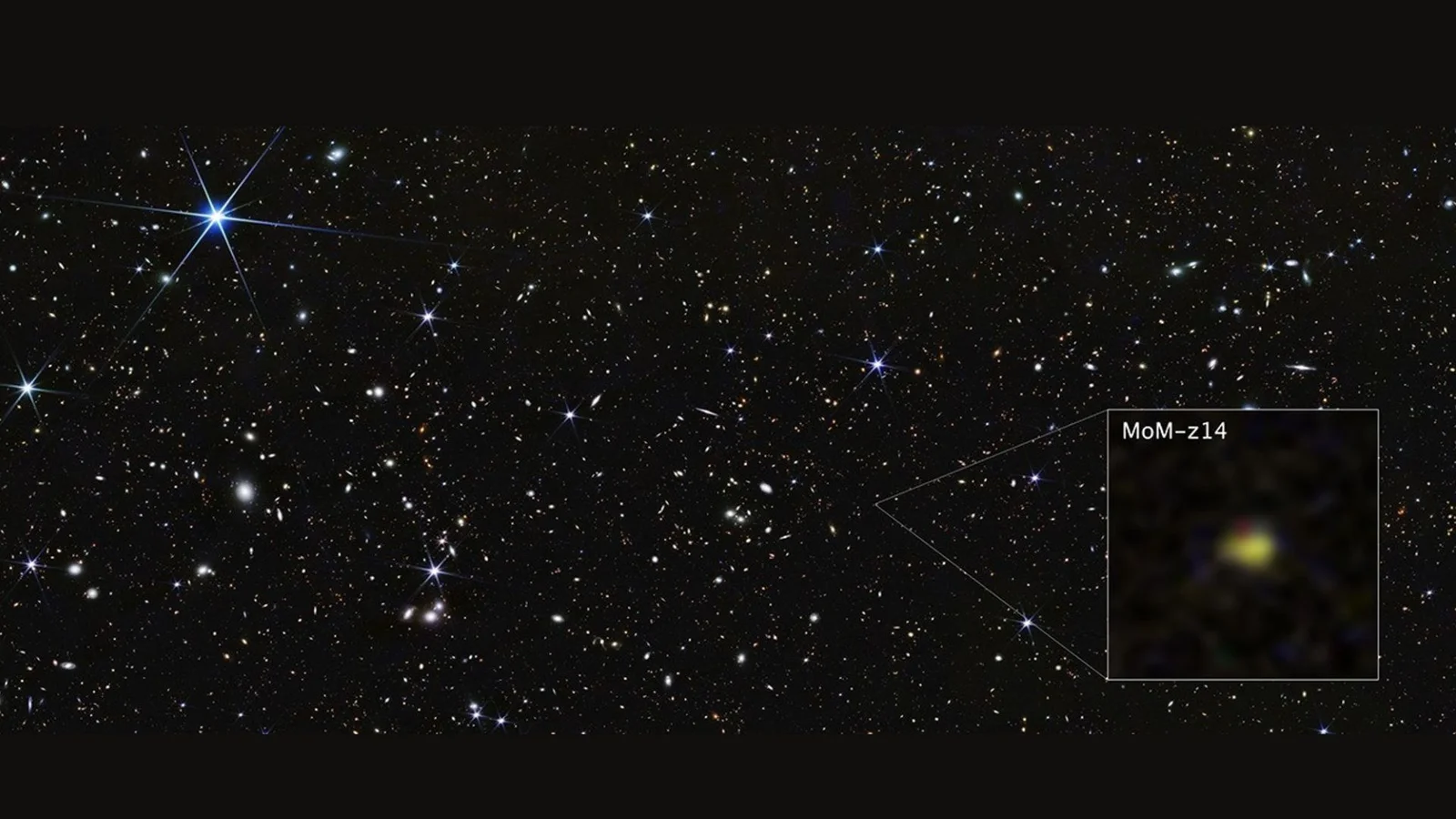
The James Webb Space Telescope has spectroscopically confirmed MoM-z14, the most distant galaxy yet at redshift about 14.44 (light from ~280 million years after the Big Bang), joining a growing population of UV-bright galaxies brighter and more common than pre‑Webb models predicted. This prompts a revision of how quickly the first galaxies formed stars, while cosmology remains intact; explanations include more efficient early star formation, bursty activity, top-heavy stellar populations, reduced dust, and contributions from accreting black holes. Ongoing and future spectroscopy will measure how common these galaxies are and improve chemical enrichment estimates, such as oxygen detection, to sharpen the picture of the early universe.

JWST spots the universe’s most distant galaxy MoM-z14, challenging early-universe predictions
space5 months ago

JWST spots the universe’s most distant galaxy MoM-z14, challenging early-universe predictions

NASA’s James Webb Space Telescope has detected MoM-z14, the farthest galaxy observed to date, about 13.5 billion years back (roughly 280 million years after the Big Bang). The galaxy is brighter, more compact, and chemically enriched than expected for such an early epoch, challenging existing models of early star and galaxy formation and suggesting the early universe may have evolved more rapidly than theories predicted.

Webb Reveals Young Black Holes Behind Red Dots
science5 months ago

Webb Reveals Young Black Holes Behind Red Dots

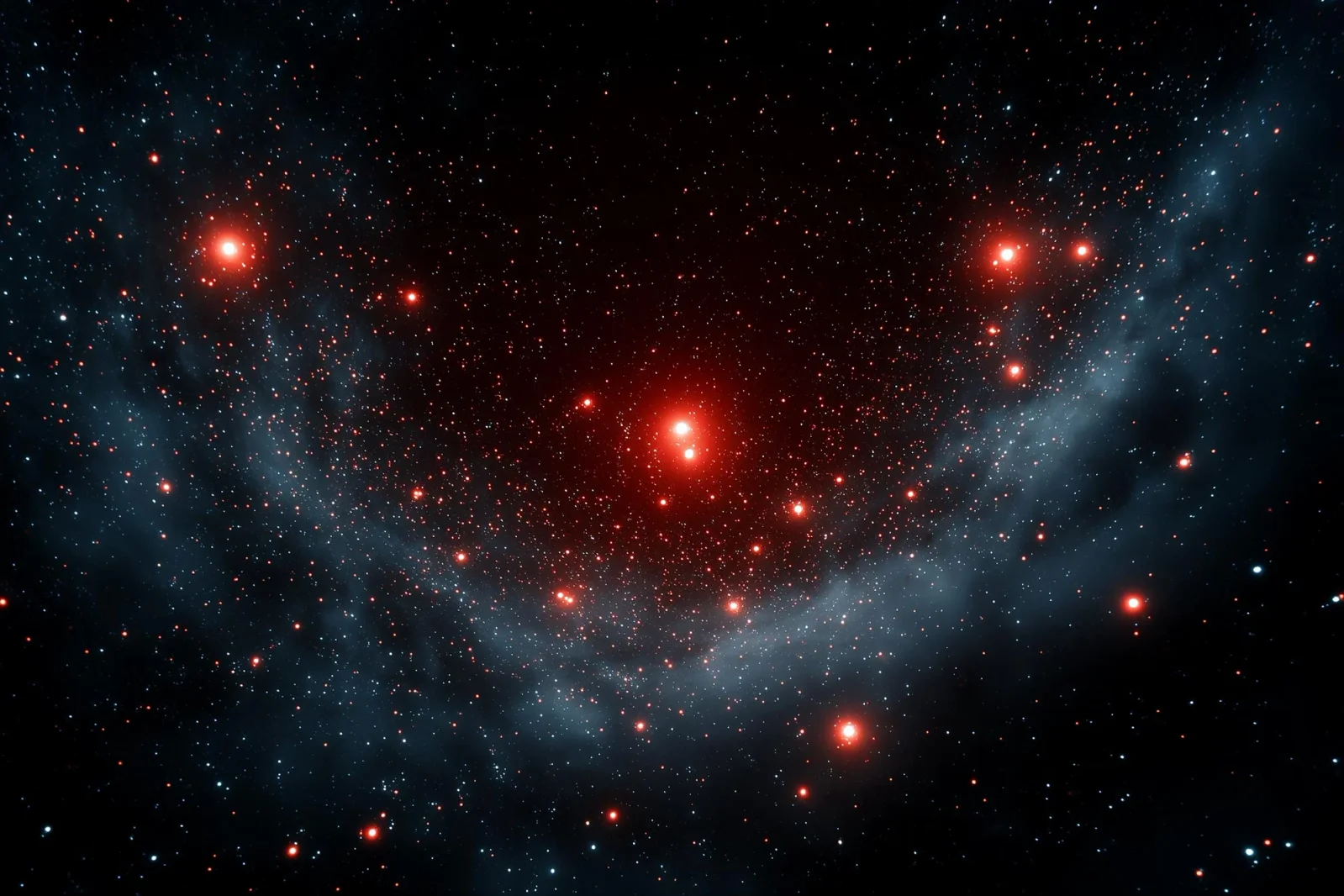
New analysis of James Webb Space Telescope images shows the universe’s “little red dots” are not distant galaxies but young, enshrouded black holes (up to ~10 million solar masses) rapidly accreting gas in dense cocoons. The heat from infalling material glows through the cocoon, producing the red hue. Hundreds have been identified, offering clues to how supermassive black holes could form within the first 700 million years after the Big Bang. The findings, published in Nature on Jan 14, 2026 by the Cosmic Dawn Centre at the University of Copenhagen, describe these “messy eaters” that grow quickly while pushing away much of the incoming gas.

Unveiling the Dawn of Time's First Light
science9 months ago

Unveiling the Dawn of Time's First Light

Recent observations from the Hubble and James Webb Space Telescopes suggest that small dwarf galaxies played a crucial role in illuminating the early Universe during cosmic reionization, challenging previous assumptions that larger galaxies and black holes were the primary sources of ionizing radiation. This discovery highlights the importance of low-mass galaxies in shaping the Universe's evolution and opens new avenues for understanding our cosmic origins.

NASA's Telescopes Offer New Insights into Interstellar Comet 3I/ATLAS
science10 months ago

NASA's Telescopes Offer New Insights into Interstellar Comet 3I/ATLAS

Scientists are exploring the possibility of using spacecraft to observe and study interstellar comet 3I/ATLAS as it passes the sun, offering a rare opportunity to analyze material from an ancient star system formed over 7 billion years ago, which could provide insights into the early universe. The comet's perihelion will occur behind the sun from Earth's perspective, making Earth-based observations difficult, but spacecraft like JUICE, Psyche, and those orbiting Mars could capture valuable data and possibly collect material from its tail, marking a unique scientific opportunity.

James Webb Telescope Discovers 300 Mysterious Early Universe Galaxies
science10 months ago

James Webb Telescope Discovers 300 Mysterious Early Universe Galaxies

The MINERVA program utilizing the James Webb Space Telescope aims to enhance our understanding of the early universe by capturing detailed images of the first galaxies, stars, and black holes, especially during the cosmic dawn, through advanced medium-band imaging techniques that allow for more precise analysis of distant, dust-obscured objects.