
Petermann Glacier Calves Massive Ice Island, Signaling Accelerated Arctic Ice Loss
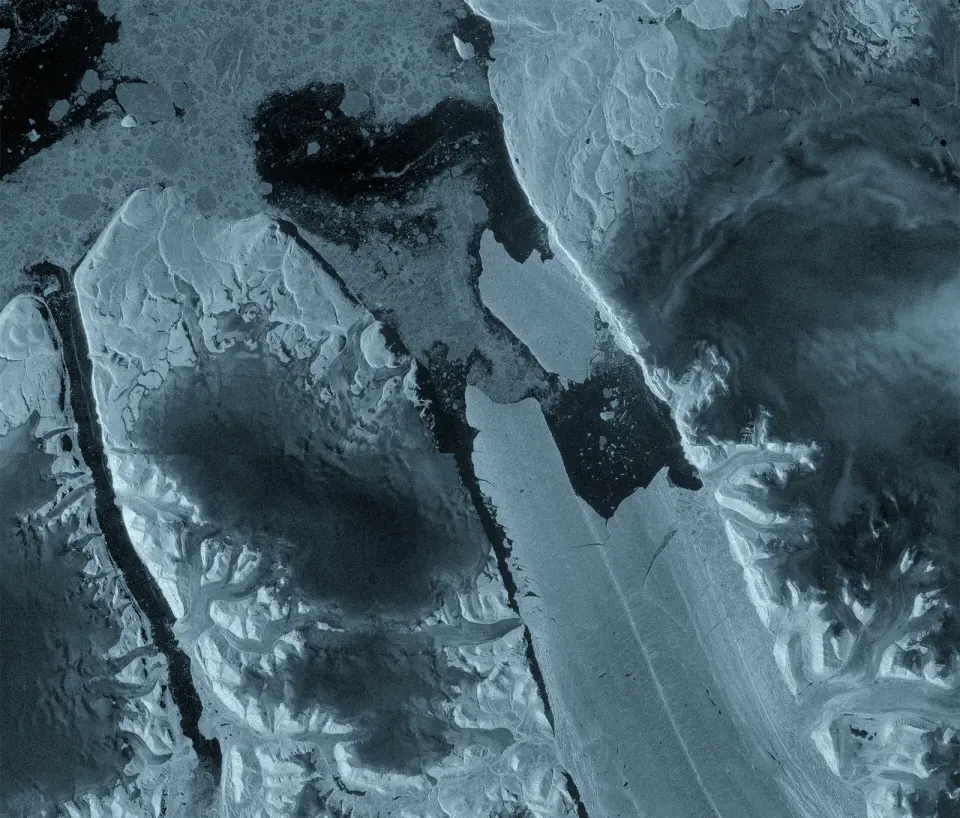
On August 4, 2026, a 76 square kilometer section of floating ice broke away from Petermann Glacier in northwest Greenland. This event, detected by ESA’s Sentinel-1 radar, is the glacier’s largest ice loss since 2012 and the most significant Arctic calving event since 2020. The resulting ice island, comparable in size to Manhattan and up to 150 meters thick, poses risks to Arctic shipping routes. While the immediate calving accounts for only 5% of the glacier’s recent mass loss, underlying basal melting from warm ocean water is the primary driver of its retreat, raising concerns about future instability and sea-level rise.
Key points
- A 76 sq km ice island detached from Petermann Glacier on August 4, 2026, marking the largest loss since 2012.
- The calving event was monitored by an international team using Sentinel-1 radar imagery, which allows observation through cloud cover.
- Researchers anticipate two additional large calving events, potentially removing another 184 sq km of ice from the glacier’s floating tongue.
- Basal melting from warm Atlantic water accounts for approximately 75% of Petermann’s recent mass loss, far exceeding surface melting and calving.
- The new ice island poses navigation risks, with Environment and Climate Change Canada monitoring its trajectory for potential impacts on shipping and infrastructure.
Background
Petermann Glacier is one of Greenland’s largest ice streams, connecting the Greenland Ice Sheet to the Arctic Ocean. Its drainage basin holds enough ice to raise global sea levels by 0.38 meters if fully lost. The glacier has a history of major calving events in 2008, 2010, and 2012, but its floating ice tongue remained relatively stable until 2026. Recent satellite data from 2026 has shown increased fracturing and rapid changes in the ice tongue, following a pattern of earlier snow melt and ice recession observed in other Arctic regions like Baffin Island in 2026.
How outlets are covering it
ESA and the international research team emphasize the technical achievement of using Sentinel-1 radar to monitor the glacier in near-real time, highlighting the value of one-day repeat data in tracking fracture propagation. They view the calving as a critical opportunity to study Arctic ice island dynamics, which are rarer than in Antarctica. In contrast, a study published in Science Advances, cited by Dailynewsegypt, focuses on the underlying causes of retreat, arguing that basal melting from warm ocean water is the primary driver (75% of mass loss), not calving (5%). This perspective warns that continued retreat could weaken the glacier’s ability to support inland ice, potentially accelerating sea-level rise. Sanskriti IAS provides a broader educational context, noting the glacier’s location near the Nares Strait and its significance as a climate change indicator, while also detailing the practical risks to Arctic navigation.
Why it matters
The calving of a massive ice island from Petermann Glacier signals a shift in the stability of one of Greenland’s most significant ice streams. While the immediate loss of floating ice does not directly raise sea levels, it indicates that the glacier is approaching a critical threshold where the loss of its floating tongue could accelerate the flow of grounded ice into the ocean. This could have substantial long-term impacts on global sea levels. Additionally, the drifting ice island poses immediate risks to Arctic shipping routes and offshore infrastructure, highlighting the practical consequences of climate change on global trade and safety.
What to watch
Researchers will continue to monitor the newly calved ice island and Petermann Glacier using satellite imagery, aerial observations, and tracking data to understand its movement and fragmentation. Environment and Climate Change Canada is assessing the iceberg’s trajectory to mitigate risks to shipping. Scientists anticipate two further large calving events, which could remove an additional 184 sq km of ice from the glacier’s floating tongue. Long-term monitoring will focus on how the glacier’s retreat affects inland ice flow and contributes to sea-level rise.
- Sentinel-1 captures major ice loss from Greenland glacier European Space Agency
- Sentinel-1 interferometry highlights fractures of Petermann ice tongue European Space Agency
- Greenland’s Petermann Glacier edges closer to dangerous retreat Dailynewsegypt
- Greenland's Petermann Glacier Calves Massive Ice Island: Largest Arctic Calving Event Since 2020 Sanskriti IAS
- Size of new iceberg calved from Petermann Glacier European Space Agency
Want the full story? Read the original reporting
Read on European Space Agency