
Greenland's 76-Square-Kilometer Ice Island Survives Collision with Joe Island
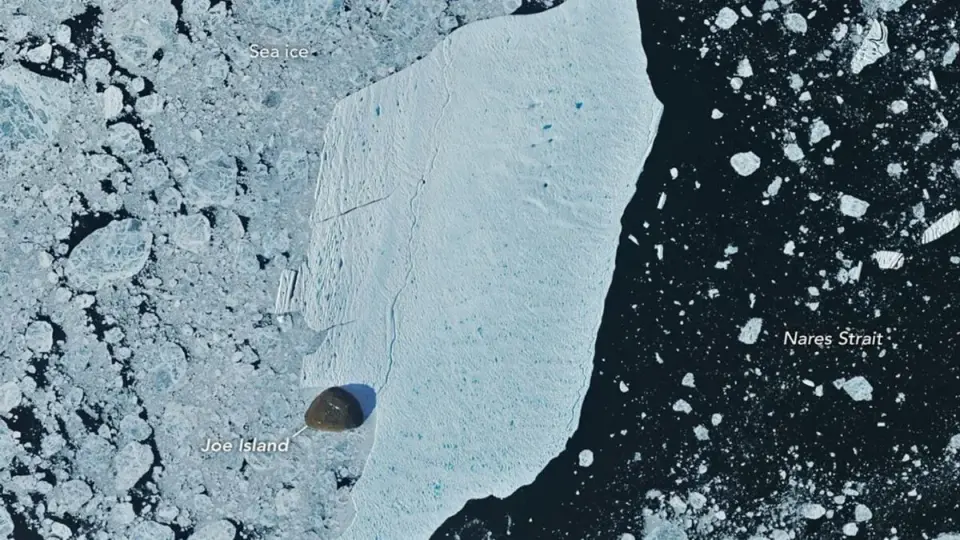
A massive ice island, roughly the size of Manhattan, calved from Greenland's Petermann Glacier on August 4, 2026. After drifting through Petermann Fjord, it collided with Joe Island but survived the impact without fragmenting. The event marks the largest floating ice loss from the glacier since 2012 and the most significant Arctic calving since 2020. Scientists anticipate two additional large calving events in the near future.
Key points
- The ice island measured approximately 76 square kilometers (29 square miles) and up to 150 meters thick at the time of calving.
- It detached from Petermann Glacier's floating ice tongue on August 4, 2026, following months of observed fracture propagation.
- The iceberg drifted at an average of 3 kilometers per day before colliding with Joe Island at the mouth of Petermann Fjord.
- Despite the collision, the ice island remained intact and continued southwest through Nares Strait, aided by wind and surface currents.
- Researchers expect two further large calving events, estimated at 94 and 84 square kilometers, as remaining rifts continue to spread.
Background
Petermann Glacier is one of Greenland's largest marine-terminating glaciers and a key gatekeeper for ice flowing into the ocean. Previous major calving events occurred in 2008, 2010, and 2012, with the 2010 event producing an ice island four times the size of Manhattan. Since 2019, an international team has used satellite remote sensing to monitor fractures and instability in the glacier's floating ice tongue. The August 2026 calving was the largest floating ice loss from the glacier since 2012 and the most significant Arctic calving event since 2020.
How outlets are covering it
Gizmodo and NASA Earth Observatory both confirm the ice island survived its collision with Joe Island, a rocky outcrop that often marks the beginning of an iceberg's breakup. Gizmodo emphasizes the survival as a notable event, while NASA highlights the role of wind and surface currents in sweeping the berg out of the fjord. SciTechDaily, citing ESA, stresses the rapidity of fracture propagation and the potential for two additional large calving events. All sources agree on the size and timing of the calving but differ in emphasis: Gizmodo focuses on the collision, NASA on the drift and monitoring, and SciTechDaily on the broader implications for Arctic ice dynamics and shipping risks.
Why it matters
The calving of a 76-square-kilometer ice island from Petermann Glacier underscores the ongoing instability of Greenland's marine-terminating glaciers and their potential impact on sea-level rise. The survival of the ice island after colliding with Joe Island provides valuable data for understanding the behavior of large Arctic ice masses. Additionally, the anticipated further calving events and the potential hazards posed by drifting ice islands to marine activities and infrastructure highlight the need for continued monitoring and preparedness in the Arctic region.
What to watch
Scientists will continue to monitor the drifting ice island as it fractures into smaller pieces due to tides, winds, currents, and melting. They will also track the two remaining large rifts in Petermann Glacier, which are expected to produce additional ice islands of approximately 94 and 84 square kilometers. Environment and Climate Change Canada is evaluating potential threats to shipping routes and infrastructure posed by the drifting ice masses.
- Greenland’s Wayward Ice Island Just Smashed Into Joe Island—and Survived Gizmodo
- Ice Island Survives Run-In With Joe Island science.nasa.gov
- Greenland Just Lost a Manhattan-Sized Slab of Ice SciTechDaily
- The most dramatic proof of our current climate catastrophe ever caught on camera yahoo.com
- Massive Greenland iceberg hits Joe Island, survives without breaking apart | It was estimated to be around 150 metres thick | Inshorts Inshorts
Want the full story? Read the original reporting
Read on Gizmodo