
Spin diffusion links distant oscillators in semiconductor time crystals
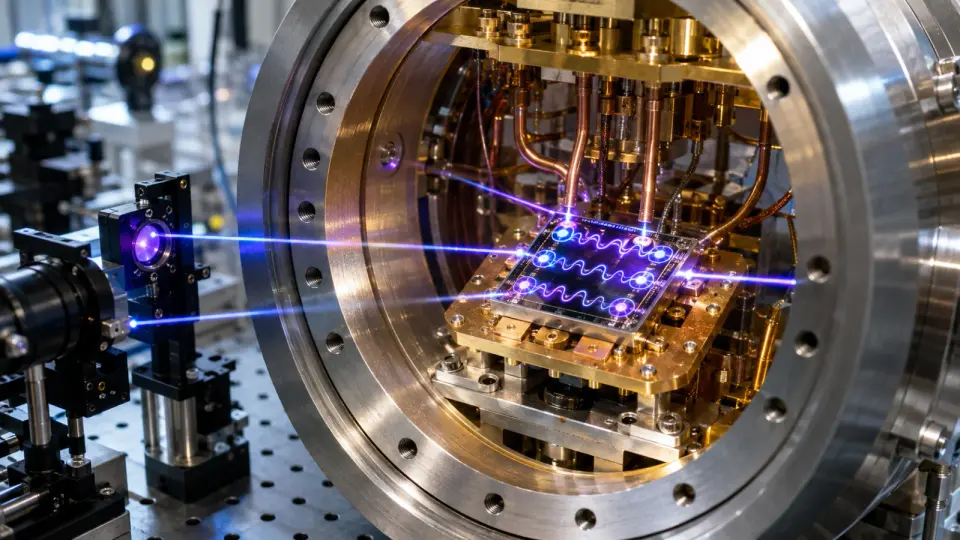
Researchers at TU Dortmund University have demonstrated that continuous time crystals in a semiconductor can synchronize across distances of up to 38 micrometers. By using indium gallium arsenide (InGaAs) cooled to near absolute zero, the team showed that electron spin diffusion allows separate spin oscillators to lock into a shared rhythm, even when their natural frequencies differ by 40%. This finding suggests that future spintronic devices could use collective phase dynamics for information processing, moving beyond isolated oscillators to coherent, macroscopic states.
Key points
- The study, published in Nature Communications, builds on a 2024 demonstration of long-lived continuous time-crystal oscillations in semiconductors.
- InGaAs layers doped with silicon were used, where localized electrons couple to approximately one million nuclear spins via the hyperfine interaction.
- Circularly polarized pump light aligns electron spins, which transfer polarization to nuclei, creating an Overhauser field that drives persistent oscillations.
- When the pump beam was widened to 200 micrometers, all measured locations oscillated at the same frequency, despite natural frequency variations across the sample.
- Two separate pump lasers showed synchronization at 25-micrometer spacing, collapsing distinct frequencies (91 mHz and 69 mHz) into a single intermediate frequency of 80 mHz.
- Synchronization disappeared at 50-micrometer spacing, with a measured range of 38 ± 3 micrometers between pump centers.
Background
This research follows earlier work by the same team in January 2024, which demonstrated long-lived continuous time-crystal oscillations in semiconductors. The current study extends that work by showing how these oscillators can synchronize across mesoscopic distances, providing a mechanism for collective behavior in quantum spin systems. It also aligns with broader trends in quantum physics research, such as the exploration of dissipative continuous time crystals and time crystals in coupled exciton-polariton condensates, as noted in related literature from 2025 and 2026.
Why it matters
The ability to synchronize time crystals across distances could lead to the development of controllable networks of spin oscillators, enabling new forms of information processing in spintronic and neuromorphic systems. This research also explains the stability of earlier time-crystal oscillations, as a many-body synchronized state can resist local disorder and fluctuations. The findings may pave the way for technologies that process information through collective phase dynamics rather than discrete logic states, potentially advancing quantum computing and advanced semiconductor applications.
What to watch
The researchers suggest that electrically controlled gating or lateral drift could make the coupling between spin oscillators tunable, rather than passive. This could allow for the creation of networks of spin oscillators for spintronic systems or analog neuromorphic architectures. Further experiments may explore how to manipulate and control these synchronized states, potentially leading to practical applications in quantum information processing and advanced semiconductor devices.
Want the full story? Read the original reporting
Read on The Brighter Side of News