Spin diffusion links distant oscillators in semiconductor time crystals
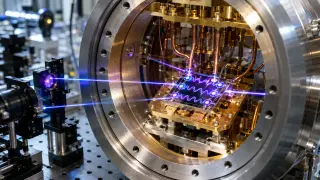
Researchers at TU Dortmund University have demonstrated that continuous time crystals in a semiconductor can synchronize across distances of up to 38 micrometers. By using indium gallium arsenide (InGaAs) cooled to near absolute zero, the team showed that electron spin diffusion allows separate spin oscillators to lock into a shared rhythm, even when their natural frequencies differ by 40%. This finding suggests that future spintronic devices could use collective phase dynamics for information processing, moving beyond isolated oscillators to coherent, macroscopic states.