
Fossil Evidence Suggests Live Birth Emerged 90 Million Years Earlier Than Thought
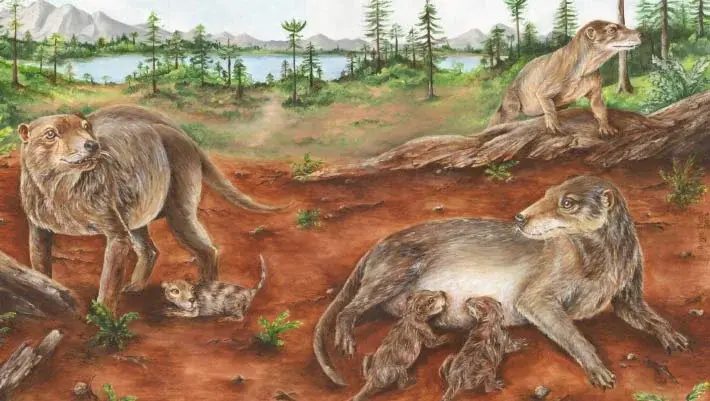
A 236-million-year-old cynodont fossil from Argentina provides the earliest evidence of live birth, pushing the origin of viviparity back by up to 95 million years. Researchers identified a 'neonatal line' in the bone, indicating the animal was born at 10-20% of its adult weight, a ratio consistent with modern placental mammals rather than egg-laying reptiles. This challenges the assumption that all non-mammalian cynodonts laid eggs and suggests live birth may have evolved earlier in the mammalian lineage than previously believed.
Key points
- Fossil of Chiniquodon theotonicus, a cat-sized cynodont from the Triassic period in northwestern Argentina, shows evidence of viviparity.
- Bone analysis revealed a 'neonatal line' marking birth, with the newborn estimated at 1.68 kg, or 10-20% of its 12 kg adult mass.
- This newborn-to-adult weight ratio aligns with modern placental mammals, not egg-laying reptiles, birds, or monotremes.
- The finding pushes the origin of live birth back by 90-95 million years, challenging the view that it evolved only within therian mammals.
- Researchers propose two scenarios: independent evolution in cynodonts and therians, or a single early origin with monotremes reverting to egg-laying.
Background
Recent paleontological discoveries have repeatedly pushed back the timelines of key evolutionary traits. For instance, 2026 studies on Egyptian ape fossils and Devonian amber have redefined the origins of modern apes and plant resin production, respectively. Similarly, this new finding on viviparity revises the understanding of mammalian reproductive evolution, suggesting that complex traits like live birth emerged earlier in the cynodont lineage than previously assumed.
How outlets are covering it
Sci.News and Science News both emphasize the significance of the 'neonatal line' and the weight ratio as evidence for viviparity, highlighting the 90-95 million year shift in the timeline. Gizmodo focuses on the discovery process, noting that co-author Maria Miceli Baro identified embryonic tissue during routine bone microstructure analysis. All three sources agree that the findings challenge the long-held assumption that cynodonts laid eggs, but they differ in emphasis: Sci.News and Science News stress the evolutionary implications, while Gizmodo highlights the serendipitous nature of the discovery and the potential for broader shifts in cynodont reproduction.
Why it matters
This discovery reshapes the understanding of mammalian evolution by suggesting that live birth, a key trait for mammalian success, emerged much earlier than thought. It challenges the assumption that egg-laying was universal among non-mammalian cynodonts and implies that the transition to viviparity may have been a broader, earlier shift in the mammalian lineage. This could influence future research into the evolution of other mammalian traits, such as lactation and placental development.
What to watch
Researchers plan to examine other cynodont fossils for similar embryonic tissues to test whether live birth was widespread among these ancestors. Further studies may clarify whether viviparity evolved once early in the mammalian lineage or independently in multiple branches, potentially resolving the debate over the evolutionary path from egg-laying to live birth.
- Fossil Evidence Pushes Back Origin of Live Birth by 90 Million Years Sci.News
- These mammal ancestors birthed live young far earlier than thought sciencenews.org
- A 236-million-year-old fossil challenges the story of mammalian live birth Phys.org
- Ancient Fossil Changes the History of Live Birth Newser
- This 236-Million-Year-Old Fossil Just Rewrote the Story of Live Birth Gizmodo
Want the full story? Read the original reporting
Read on Sci.News