
Webb telescope discovers ancient galaxies and mysterious space dust.
TL;DR Summary
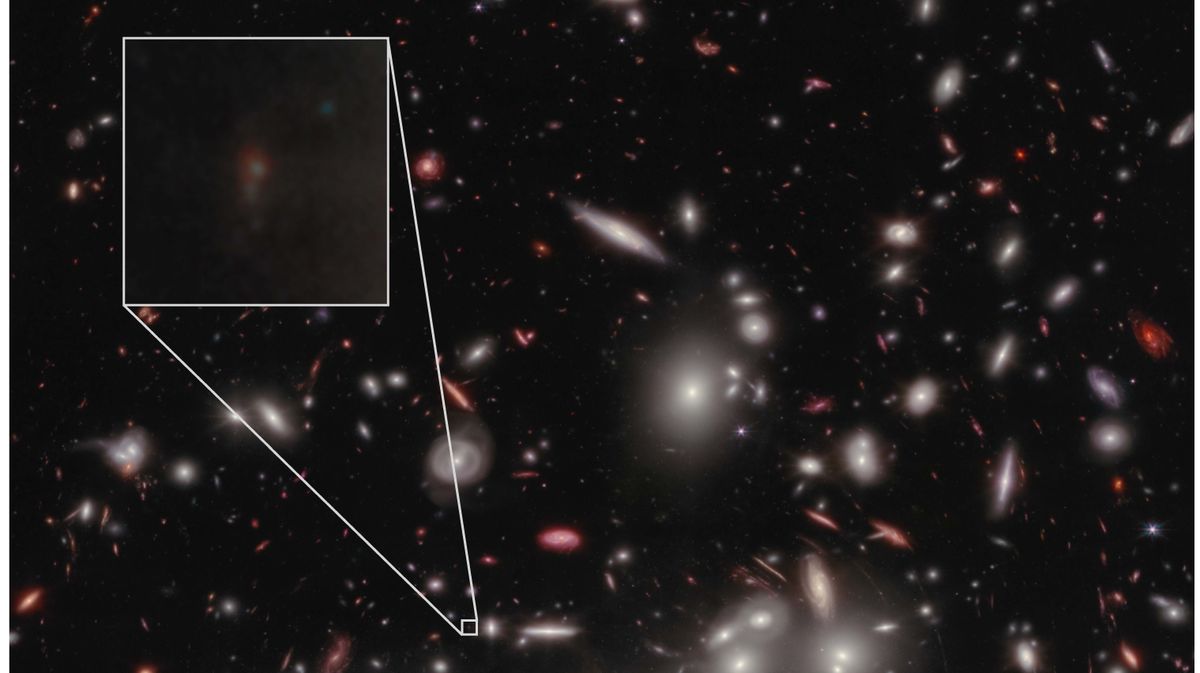
The James Webb Space Telescope has discovered the faintest galaxy yet seen in the early universe, known as JD1, which is part of the first generation of galaxies to pop up in our universe's 13.8-billion-year history. It's about 13.3 billion light-years away from us, meaning we're observing it as it looked when the universe was only a few hundred million years old. Astronomers used a technique called gravitational lensing, in which light from a distant object is bent by the gravity of something huge in the foreground, like a cluster of galaxies, to observe JD1.
Topics:science#early-universe#galaxy#gravitational-lensing#james-webb-space-telescope#reionization#science-and-astronomy
- James Webb Space Telescope spots faintest galaxy yet in infant universe Space.com
- Webb telescope detects organic molecules in distant galaxy CNN
- James Webb Space Telescope finds the faintest galaxy ever detected at the dawn of the universe Livescience.com
- Strange Phenomenon Predicted by Einstein Reveals Oldest Evidence of Mysterious Space Dust Inverse
- Webb spots galactic smoke signals from across the universe New Atlas
Reading Insights
Total Reads
1
Unique Readers
13
Time Saved
2 min
vs 3 min read
Condensed
83%
566 → 95 words
Want the full story? Read the original article
Read on Space.com