
Fossil Fuels Halted a Glacial Rebound That Began 2,000 Years Ago
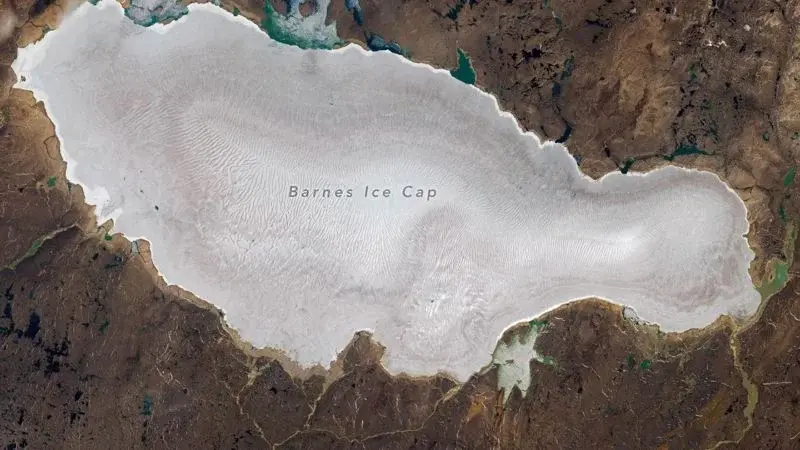
A new study in Science argues that human-driven warming abruptly reversed the natural regrowth of the Barnes Ice Cap in the 1960s, effectively canceling the onset of the next ice age. Researchers used ancient plant remains and rock isotopes to show that the last remnant of the massive Laurentide Ice Sheet began expanding roughly 2,000 years ago but started shrinking as fossil fuel emissions rose. While some experts question whether this single site proves a global glacial inception, the findings suggest anthropogenic climate change has fundamentally altered Earth’s natural orbital cycles, potentially delaying future glaciations for millennia.
Key points
- The Laurentide Ice Sheet, which once covered much of North America, now survives only as the Delaware-sized Barnes Ice Cap on Baffin Island, Canada.
- Researchers found that the ice cap reached its minimum size around 3,000 years ago and began regrowing approximately 2,000 years ago due to natural cooling trends.
- This regrowth reversed in the 1960s as rising summer temperatures from greenhouse gas emissions caused the ice to melt faster than it could accumulate.
- The Barnes Ice Cap is frozen to bedrock, preserving ancient mosses and lichens that allowed scientists to date the ice’s expansion and retreat using radiocarbon and Beryllium-10 analysis.
- The study suggests that the initial regrowth of an ice sheet marks the beginning of a glacial period, challenging models that predict the next ice age is 50,000 years away.
- The findings validate 1970s scientific warnings about a pending ice age, which were later dismissed by climate skeptics, while showing that current warming has likely postponed future glaciations indefinitely.
Background
Recent archaeological findings, such as the discovery of a 10,000-year-old mastodon molar in California and human footprints in New Mexico, have provided new insights into life during the Last Glacial Maximum. These discoveries highlight the extreme environmental shifts of the past, contrasting with the current study’s focus on how modern human activity has disrupted the natural cycles that previously drove these glacial periods.
How outlets are covering it
CNN and WIRED emphasize the dramatic narrative that fossil fuels 'accidentally' canceled the next ice age, framing the 1960s reversal as a direct result of industrial emissions. The Lamont-Doherty Earth Observatory, the study’s home institution, highlights the technical novelty of using preserved vegetation to track ice margins, arguing that the regrowth itself constitutes the start of a glacial period. New Atlas provides a more cautious interpretation, noting that while the data is robust, it is unclear if a single ice cap’s behavior represents a global glacial inception. External experts like Meredith Kelly of Dartmouth College and Andrey Ganopolski of the Potsdam Institute express skepticism, arguing that the evidence from one location is insufficient to prove a global ice age began, and that models suggest the next glacial period is still decades away even without human interference. Andrew Wickert of the University of Minnesota Twin Cities supports the finding, stating that the rapid retreat of the Barnes Ice Cap demonstrates the significant impact of early emissions on major ice sheets.
Why it matters
This research redefines the timeline of Earth’s climate cycles, suggesting that human influence has already altered natural glacial patterns. It challenges the notion that the next ice age is far in the future, implying that anthropogenic warming has not only prevented a recent glacial onset but may have permanently delayed future glaciations. This has profound implications for long-term climate modeling and validates historical scientific predictions that were previously dismissed by skeptics.
What to watch
Scientists will likely seek comparative data from other global ice caps to confirm if the Barnes Ice Cap’s behavior reflects a broader glacial trend. The complete disappearance of the Barnes Ice Cap within the next few centuries is projected, which may alter the dynamics of future glaciations by removing a key nucleation point for ice growth. Further research will focus on understanding the mechanisms that trigger glacial inception and how current greenhouse gas levels impact these natural cycles.
- Humans accidentally canceled the next ice age — but it’s no reason to celebrate, scientists say CNN
- Global warming may have prevented a return to the ice age 2,000 years ago New Atlas
- Climate Change Stopped the Next Ice Age Lamont-Doherty Earth Observatory
- A New Ice Age Was Beginning. Then Humans Started Burning Fossil Fuels WIRED
- Two Thousand Years Ago, a New Ice Age Began—but Human-Caused Climate Change Recently Reversed It, According to New Research Smithsonian Magazine
Want the full story? Read the original reporting
Read on CNN