
NOAA’s Deep Discoverer Samples Radioactive Nodules in American Samoa to Test Mining Viability
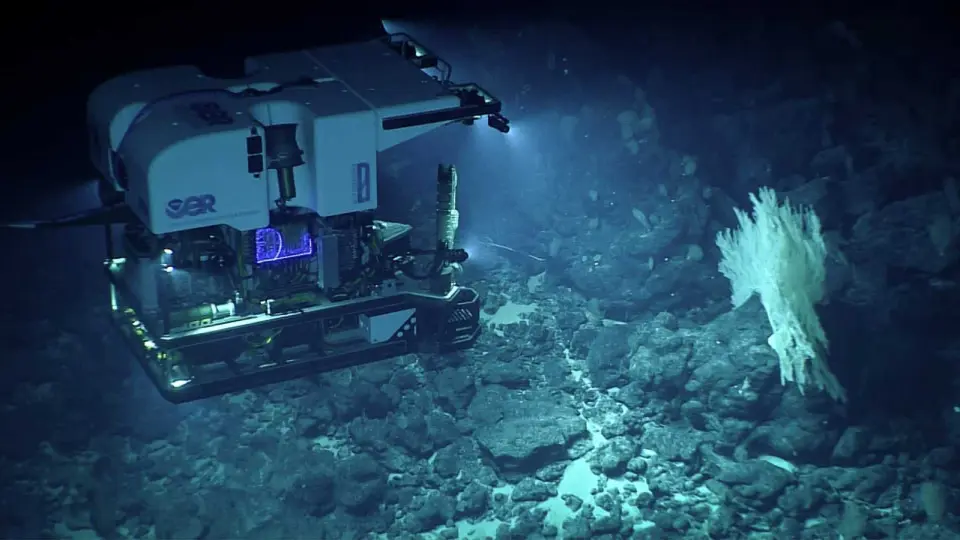
NOAA’s Deep Discoverer robot collected polymetallic nodules and water samples from the seafloor off American Samoa to assess critical mineral deposits and test a radon-based detection method. The expedition, conducted on the Okeanos Explorer, aims to establish baseline data for potential offshore mining while navigating environmental protections in the region.
Key points
- NOAA’s Deep Discoverer (D2) descended to 16,863 feet (5,140 meters) off American Samoa to collect samples using a 10-inch quadrat frame.
- The collected nodules contain nickel, cobalt, copper, and manganese, which are critical for electric vehicle batteries.
- Scientists are testing whether radon gas, a decay product of thorium in the nodules, can be used to detect nodule fields from the water column without direct seafloor contact.
- The expedition took place within the National Marine Sanctuary of American Samoa, where deep-sea mining is currently prohibited.
- Weather disruptions delayed the initial dive schedule, with the key sampling occurring on August 31, 2026.
Background
This expedition follows recent international efforts to assess deep-sea environmental impacts, such as the 2026 discovery of leaking radioactive waste barrels in the Northeast Atlantic. While those missions focused on historical dumping, this NOAA mission focuses on potential future mining of critical minerals. The broader context involves global debates over the environmental costs of extracting metals for the EV industry versus the need for sustainable supply chains.
How outlets are covering it
AutoNotion emphasizes the technical precision of the quadrat sampling method and the potential of radon detection to reduce the need for expensive robotic dives, highlighting the scientific rigor behind the data collection. Samoa Observer, however, frames the discovery through a lens of environmental caution, warning against the 'ugly specter' of economic excitement that disregards ecological consequences and the economic future of local populations. While AutoNotion focuses on the feasibility of mining technologies, Samoa Observer stresses the risks of unregulated exploitation.
Why it matters
The data collected could influence future U.S. policies on offshore critical mineral extraction, potentially reshaping the supply chain for EV batteries. If the radon detection method proves viable, it could make mapping nodule fields more cost-effective, accelerating the debate over mining in protected marine sanctuaries. The results will also inform environmental assessments required before any potential lifting of mining bans in the region.
What to watch
Samples are being analyzed at the US Geological Survey to validate the radon-nodule correlation. NOAA’s Okeanos Explorer is transiting to Suva, Fiji, with a second expedition planned for late September 2026 to revisit the same waters. Further dives are scheduled to test additional nodule fields in the central Samoa Basin.
- A 9,700-pound drone with 28 lights on it set a 10-inch square down on the seafloor 16,863 feet off American Samoa, scooped out the metal lumps growing inside that square, and bottled the water just above them to test whether a radioactive gas can find more Autonocion.com
- Barnacles and Amphipods NOAA Ocean Exploration (.gov)
- ROV Dives Reveal Life More Than Five Kilometres Beneath American Samoa Scubaverse
- Deep-sea exploration finds polymetallic nodule field around American Samoa Samoa Observer
- Anemone, Sponge, Megalodon Tooth NOAA Ocean Exploration (.gov)
Want the full story? Read the original reporting
Read on Autonocion.com