
Tonga Caldera Collapse: 1km Drop, 8.9km3 Displaced, and a 17-Minute Warning Gap
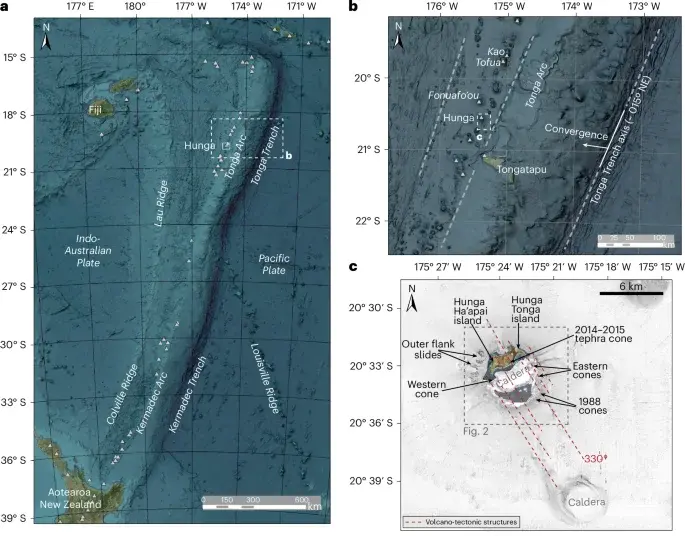
New research confirms the 2022 Hunga Tonga eruption caused a rapid, piston-style caldera collapse that displaced 8.9 cubic kilometers of material, generating a massive tsunami. While acoustic signals reached global monitoring stations 17 minutes before the wave, existing algorithms failed to convert this data into a warning, highlighting a critical gap in volcanic tsunami preparedness.
Key points
- The 2022 Hunga Tonga eruption triggered a caldera collapse that deepened the seafloor from 150m to 850m, displacing 8.9 km3 of material, with 6.85 km3 attributed to the collapse itself.
- The collapse occurred synchronously with the eruption, evidenced by landslide deposits intercalated with volcanic ash, and involved the withdrawal of approximately 8 km3 of magma, less than 30% of the reservoir.
- Acoustic T-waves from the collapse reached distant monitoring stations 17 minutes before the tsunami arrived, but current systems lack algorithms to identify these signals as tsunami precursors.
- The event caused tsunami runups of up to 40m within 100km, damaging over 190km of submarine cables, while the low death toll was partly due to the caldera's orientation away from populated areas.
- Researchers emphasize that closing the warning gap requires developing software to classify volcanic collapse signals within existing nuclear-test monitoring networks, rather than building new infrastructure.
Background
This event follows a pattern of heightened volcanic activity in the Pacific, including the 2026 Anak Krakatau eruption and ongoing unrest at Campi Flegrei and Kīlauea. Previous studies on Toba and other calderas have shown long-term hazards, but the Hunga Tonga case uniquely demonstrates the immediate, catastrophic potential of submarine caldera collapse and the specific technical barriers to warning populations in time.
How outlets are covering it
Nature and the Korea Polar Research Institute focus on the physical mechanics, confirming a 'piston-style' collapse that displaced 8.9 km3 of material and generated the tsunami. Tech Times shifts the focus to the technological failure, arguing that while the acoustic signal was detected globally, the lack of specific algorithms for volcanic T-waves prevented any warning. While Nature highlights the geological rarity of such rapid collapse, Tech Times emphasizes that the infrastructure exists but is misconfigured for this specific hazard, contrasting the physical event with the systemic response gap.
Why it matters
The findings reveal a critical vulnerability in global disaster preparedness: existing monitoring networks can detect the acoustic signatures of catastrophic submarine collapses but cannot translate them into alerts. This gap leaves populations in volcanic regions unprotected against tsunamis that can arrive with little to no seismic warning, necessitating urgent software development to leverage existing infrastructure for life-saving early warning systems.
What to watch
Researchers are working to develop and validate algorithms that can distinguish caldera-collapse T-waves from other seismic signals in real-time. The goal is to integrate these capabilities into the existing CTBTO monitoring network to provide early warnings for volcanic tsunamis by 2030, addressing the 'bathymetric occlusion' challenges that currently distort signal accuracy.
- Rapid submarine caldera collapse during the 2022 climactic eruption of Hunga volcano (Tonga) Nature
- 1 km Collapse of the Ocean Floor During Tonga Volcanic Eruption: 'Piston-Type Collapse' That Amplified the Tsunami [Reading Science] asiae.co.kr
- Volcanic Tsunami Warning Systems Receive Collapse Signal; No Algorithm Converts It to Alert Tech Times
- Underwater Caldera Collapsed Vertically 1 km During Tonga Volcanic Eruption, Amplifying Tsunami finance.biggo.com
Want the full story? Read the original reporting
Read on Nature