
Duke University Uses AI and Robotics to Engineer Predictable Gut Microbiomes
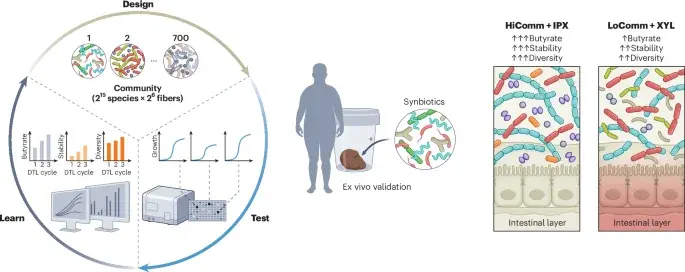
Researchers at Duke University have developed a machine learning framework to identify optimal combinations of gut bacteria and dietary fibers that consistently produce health benefits. By automating thousands of experiments, the team found a specific mix of microbes and inulin that reliably generates butyrate, a key gut health metabolite, regardless of individual biological variability.
Key points
- Duke University engineers used AI and robotic automation to test trillions of potential combinations of 15 gut microbial species and 6 dietary fibers.
- The study identified a robust combination of inulin, Bacteroides uniformis, Anaerostipes caccae, and Prevotella copri that consistently produces butyrate.
- This approach aims to solve the unpredictability of current probiotics by designing the microbial environment rather than just introducing strains.
- The team is currently testing this combination in mouse models of inflammatory bowel disease with promising early results.
Background
Recent research highlights the complex relationship between diet and gut health. Earlier studies noted that plant-based diets reshape the microbiome to boost beneficial metabolites, while others linked specific gut byproducts like TMAO to heart risks. These findings underscore the need for precise, individualized interventions, which the new Duke methodology aims to provide by moving beyond generic probiotic supplements.
How outlets are covering it
Nature Chemical Biology frames the development as a breakthrough in synthetic biology, emphasizing the use of machine learning to solve the combinatorial challenge of gut health. News-Medical highlights the practical application for the $130 billion probiotic industry, noting that current products often fail due to unpredictable results. DongA Science focuses on the technical aspect of using robotic automation to fill gaps in computational models. In contrast, a separate Cornell study reported in Fingerlakes1.com suggests that fiber benefits depend on existing bacterial strains, implying that while AI can design new communities, individual genetic and microbial backgrounds remain critical factors.
Why it matters
This research offers a path toward personalized, predictable gut health interventions. By identifying robust microbial-fiber synergies, it could lead to more effective treatments for gastrointestinal diseases and a shift in the probiotic industry from trial-and-error to data-driven precision.
What to watch
The Duke team is testing the identified combination in mouse models of inflammatory bowel disease. Future work will focus on verifying if these combinations function robustly in human gut ecosystems and can be tailored to individual microbiome profiles for clinical use.
- AI design of gut microbiomes Nature
- Will dietary fiber help digestion? It might depend on your gut bacteria Medical Xpress
- Duke University engineers use robots and AI to improve gut health News-Medical
- Duke University automates lab experiments to optimize gut probiotics–fiber combinations 동아사이언스
- Cornell study links fiber benefits to specific gut bacteria strains Fingerlakes1.com
Want the full story? Read the original reporting
Read on Nature