
Human Tau Strains Retain Structural Identity in Mouse Brains, Validating Prion-Like Transmission
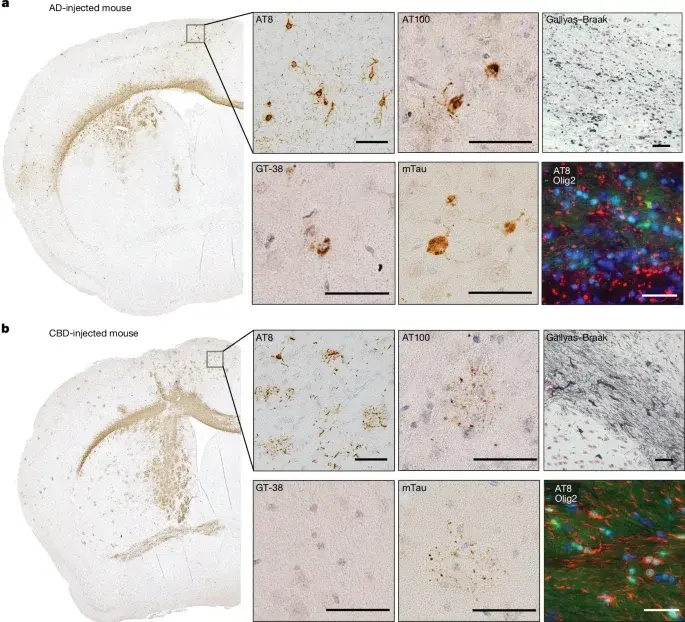
Researchers demonstrated that tau filaments from human Alzheimer’s and corticobasal degeneration brains can seed the formation of identical structures in mouse brains. This confirms that distinct tau folds act as prion-like strains, retaining their structural identity during transmission and driving disease-specific pathology.
Key points
- Injection of human tau filaments into wild-type mice resulted in the assembly of mouse tau filaments with atomic structures identical to the human seeds.
- Alzheimer’s disease seeds produced paired helical filaments, while corticobasal degeneration seeds produced single protofilaments, matching the original human conformations.
- The study confirms that tau strains propagate via templated seeding, where human seeds induce the misfolding of native mouse tau into the same conformation.
- Distinct tau folds determine cell-type specificity; Alzheimer’s seeds affected neurons, while corticobasal degeneration seeds affected both neurons and glial cells.
- Human tau seeds were cleared within one week, replaced by mouse tau inclusions that increased over nine months, proving the seeds templated new assembly rather than persisting.
Background
Recent advancements in animal modeling, such as the integration of human brain organoids into mice, have expanded the toolkit for studying neurodegeneration. However, this new study focuses on the molecular mechanism of tau propagation rather than large-scale tissue integration. It builds on prior evidence that tau spreads in a prion-like manner but provides the first atomic-level proof that specific disease strains retain their structural identity across species.
Why it matters
This finding validates the mouse as a reliable model for studying human tauopathies, as the species barrier does not prevent the transmission of 4R and 3R+4R tau strains. It provides a mechanistic basis for understanding how different tau folds drive distinct clinical phenotypes, potentially leading to better diagnostics and therapies for Alzheimer’s and related diseases.
What to watch
Researchers plan serial passage experiments to fully characterize disease-specific tau strains. Future studies will investigate whether peripheral administration of tau seeds can cause neurodegeneration and identify molecular factors that modulate tau uptake and propagation.
Want the full story? Read the original reporting
Read on nature.com