
BepiColombo to Enter Mercury Orbit After Eight-Year Journey
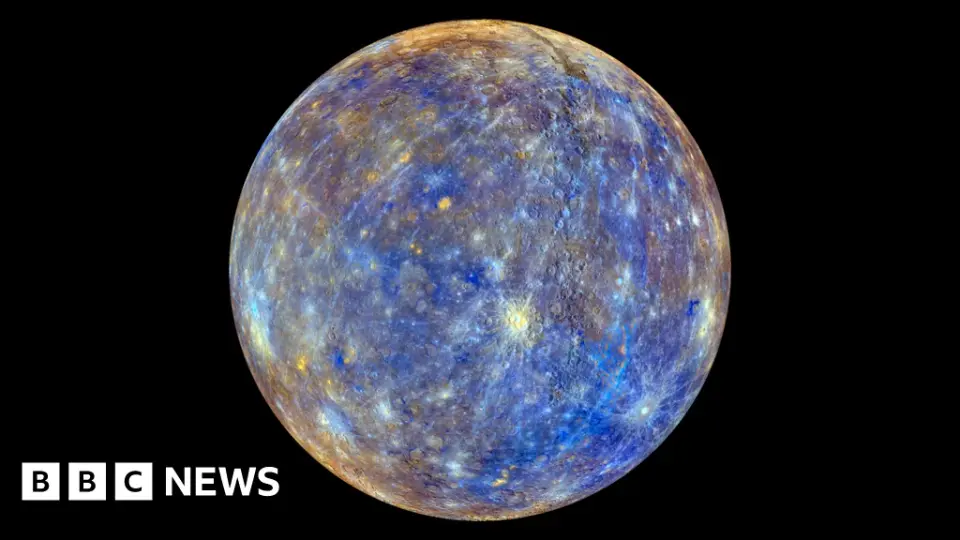
The joint European-Japanese BepiColombo mission is set to enter orbit around Mercury on November 21, 2026, after an eight-year voyage spanning nearly 6 billion miles. The mission, which launched in 2018, will split into two separate probes to study the planet's surface, magnetic field, and interior. This marks the second time a spacecraft has orbited Mercury, following NASA's Messenger mission. The arrival was delayed by one year due to propulsion issues, but the mission is now on track to begin science operations in April 2027.
Key points
- BepiColombo will enter Mercury orbit on November 21, 2026, after an eight-year journey.
- The mission will split into two probes: ESA's Mercury Planetary Orbiter and JAXA's Mercury Magnetospheric Orbiter.
- The spacecraft will study Mercury's surface, magnetic field, interior, and the presence of ice in its polar craters.
- The mission was delayed by one year due to propulsion system issues.
- Science operations are expected to begin in April 2027.
Background
Mercury is the closest planet to the Sun and the least visited in the inner Solar System. Only two spacecraft have previously visited Mercury: NASA's Mariner 10 in the 1970s and Messenger in the 2010s. The BepiColombo mission, named after Italian mathematician Giuseppe 'Bepi' Colombo, aims to solve long-standing mysteries about the planet, including its large metallic core, volcanic activity, and the presence of ice in its polar craters. The mission was launched in 2018 from French Guiana and has undergone multiple planetary flybys to slow down and enter orbit.
How outlets are covering it
BBC emphasizes the hostile environment of Mercury, with temperatures ranging from 430C to -180C, and the challenges of the mission's final orbit insertion. The Guardian highlights the scientific goals, including understanding Mercury's formation, magnetic field, and the composition of its ice. Financial Times frames the mission as a 'throwback' to old-school space exploration, contrasting it with the current US-China rivalry in space. All sources agree on the mission's significance and the complexity of its journey, but they differ in their emphasis on the scientific vs. historical aspects of the mission.
Why it matters
The BepiColombo mission represents a significant step in understanding Mercury, a planet that has been largely unexplored. The mission's findings could shed light on the formation of planets in the inner Solar System and the behavior of magnetic fields in extreme environments. Additionally, the mission's success could provide insights into space weather, which can affect power and satellite operations on Earth.
What to watch
The spacecraft will separate into two probes in early December 2026, with science operations beginning in April 2027. The probes are expected to orbit Mercury for about three years before running out of fuel and crashing into the surface. Researchers will analyze the data collected to answer long-standing questions about Mercury's surface, interior, and magnetic field.
- BepiColombo spacecraft arriving at Mercury after eight years BBC
- Spacecraft reaches Mercury on second-ever mission to enter its orbit The Guardian
- Mercury-bound X-ray telescope delivers first images after eight years in space Phys.org
- BepiColombo reaches Mercury after an eight-year cruise, according to a post citing The Guardian Digg
- An old-school mission to Mercury Financial Times
Want the full story? Read the original reporting
Read on BBC