Tag

Mercury

All articles tagged with #mercury

BepiColombo set to enter Mercury orbit after eight-year slow cruise
science9 days ago

BepiColombo set to enter Mercury orbit after eight-year slow cruise

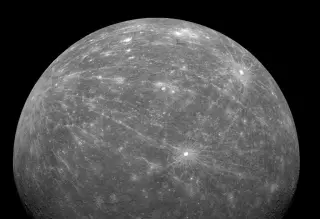
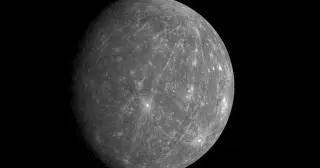
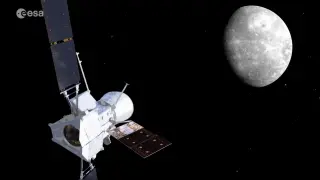
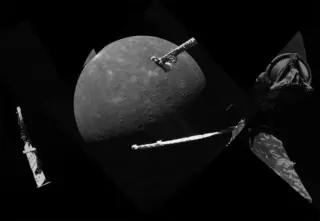
After eight years of a slow, gravity-assisted cruise powered by ion propulsion, the European-Japanese BepiColombo spacecraft will enter Mercury’s orbit in November 2026—Mercury’s third close visit and second orbiter. The arrival is gradual due to a prior thruster issue fixed in 2024, and the two orbiters will then separate to study Mercury’s surface/interior and magnetic environment, with full science operations expected to begin in 2027.

Crescent Moon Sparks Evening Triangle with Mercury and Jupiter
space25 days ago

Crescent Moon Sparks Evening Triangle with Mercury and Jupiter

On June 16, a waxing crescent Moon forms an elongated triangle with Jupiter and Mercury in the western evening sky. Mercury’s greatest eastern elongation was yesterday, and the Moon passes 3° north of Mercury around 4 PM EDT; after sunset the trio rises to about 10° high, with Pollux nearby. Venus sits above Jupiter to the upper left, and the Moon (about 6% illuminated) will occult Venus in daylight tomorrow afternoon. Sunrise is 5:31 AM and sunset 8:31 PM at 40°N, 90°W.

Daylight Moon Occults Venus in Rare 2026 Sky Show
science26 days ago

Daylight Moon Occults Venus in Rare 2026 Sky Show

On June 17, 2026, the Moon will occult Venus in broad daylight for about 29 seconds, centered around 16:40 EDT, visible from northeastern South America, the Caribbean, the CONUS, northern Mexico and southern Canada before sunset; Venus will be about 38 degrees from the Sun and around magnitude -4, while the Moon is an 11 percent crescent. This is the first of three Venus occultations in 2026 (Sept 14 and Nov 7 are the others), with Mercury near greatest elongation the day before. Plan with IOTA timings or Stellarium to target local times and try daytime video capture, noting autofocus can be tricky.

Mercury's best dusk view peaks on June 15 before sun glare returns
spaceastronomy27 days ago

Mercury's best dusk view peaks on June 15 before sun glare returns

Mercury reaches its greatest elongation of about 17 degrees from the Sun on June 15, making it one of this year’s best opportunities to spot the inner planet after sunset in the western sky, with Jupiter and Venus nearby and a slim Moon also visible; after this date Mercury will slowly fade toward the horizon, heading toward an inferior conjunction on July 12 and a shift to the morning sky later in the year.

Mercury’s Day Is Longer Than Its Year: 176 Earth-Day Sunrises
space29 days ago

Mercury’s Day Is Longer Than Its Year: 176 Earth-Day Sunrises

Mercury’s solar day (sunrise to sunrise) lasts 176 Earth days, because the planet spins once every 59 Earth days but orbits the Sun every 88 days, locking into a 3:2 spin-orbit resonance. As a result, a given spot on Mercury faces the Sun for two Mercury years before sunrise repeats, and the Sun can appear to rise, set, and rise again in a single day. This geometry—paired with a thin atmosphere—produces extreme day-night temperatures and explains why a “day” on Mercury is two years long, even though its year is just 88 days.

Twilight Trio: Mercury, Venus and Jupiter Create Brief 3-Planet Parade
space1 month ago

Twilight Trio: Mercury, Venus and Jupiter Create Brief 3-Planet Parade

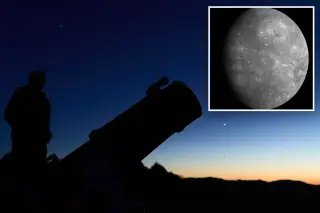
Mercury, Venus and Jupiter align low in the western sky just after sunset on June 12 for a brief, visually striking 'planetary parade' that lasts about 30–45 minutes. Venus will be the brightest at first, followed by Mercury and Jupiter as they drift away from the sun. Telescopes can reveal Mercury’s half‑moon and Venus’s gibbous disk, while Jupiter may show cloud belts. For photographers, a wide‑angle lens framing the trio over a landscape (mountains, city skyline, or trees) makes for a dramatic twilight image.

Mercury Is Earth's Nearest Neighbor on Average Across Orbits
space1 month ago

Mercury Is Earth's Nearest Neighbor on Average Across Orbits

Although Venus is often cited as Earth’s closest planetary neighbor, long‑term averaging of planetary distances shows Mercury stays nearest to Earth overall. Using a point‑circle method and a 10,000‑year orbital simulation, Mercury is closest to Earth about 47% of the time (Venus ~36%, Mars ~17%), and Mercury is the closest planet on average to every other planet as well due to its tight, Sun‑hugging orbit. This doesn’t mean Mercury ever gets closer than Venus at its nearest approach, nor does it change the solar system’s layout; for spacecraft planning, launch geometry and transfer windows remain the practical focus, with Venus and Mars as the near targets.)

Mercury Joins Venus and Jupiter in the After-Sunset Sky
observing1 month ago

Mercury Joins Venus and Jupiter in the After-Sunset Sky

Mercury becomes readily visible for a short time after sunset, lining up with Venus and Jupiter in the evening sky. Mercury is about magnitude -1.1 and roughly 6° above the western horizon; Jupiter shines high in eastern Gemini at magnitude -1.9, with Venus (magnitude -3.9) between them. To spot Mercury, draw a line from Jupiter through Venus toward the horizon. Sunset is around 8:17 PM and sunrise about 5:37 AM (local time).

Crescent Moon Tags Beehive Cluster as Planets Line Up After Sunset
space1 month ago

Crescent Moon Tags Beehive Cluster as Planets Line Up After Sunset

Look west after sunset on May 21 to spot a crescent Moon near the Beehive Cluster (Messier 44) in Cancer, with Jupiter nearby to the lower right and Venus and Mercury forming a diagonal line beyond; Mercury will be very close to the horizon, so a clear view is needed. Binoculars will reveal the Beehive cluster, and a small telescope can show lunar craters along the terminator as the Moon drifts away and sets in the early hours of May 22.

Mercury’s Hidden Diamond Layer Redefines Its Inner Story
astronomy2 months ago

Mercury’s Hidden Diamond Layer Redefines Its Inner Story

A study suggests Mercury might contain a 9–11 mile (15–18 km) thick diamond layer at the core–mantle boundary, formed as carbon-rich material crystallized during magma-ocean cooling and core solidification, with sulfur facilitating diamond stability; such a layer could affect heat flow and Mercury’s magnetic field, but the idea awaits confirmation from future missions.

Lab-Baked Mercury Rocks Reveal Sulfur's Big Role in Planetary Chemistry
space-and-spaceflight2 months ago

Lab-Baked Mercury Rocks Reveal Sulfur's Big Role in Planetary Chemistry

Researchers at Rice University used the Indarch meteorite to create Mercury-analog rocks in a lab, exposing how sulfur shapes Mercury’s crust and magmatic history. By simulating Mercury-like temperatures and pressures, they found sulfur replaces oxygen’s usual bonding partners on Earth, binding with elements like magnesium and calcium instead of iron, which weakens silicate structures and may prolong magmatic activity. The work, published in Geochimica et Cosmochimica Acta, offers a new approach to understanding Mercury’s unique, sulfur-rich surface chemistry without direct samples from the planet.

April 12, 2026: A Zodiac Lookahead of Bold Moves and Keen Insights
lifestyle3 months ago

April 12, 2026: A Zodiac Lookahead of Bold Moves and Keen Insights

April 12, 2026’s lookahead pairs Mercury’s transit with the Sun and Mars to energize some signs while prompting caution or debate for others: Aries blazes ahead with clarity, Taurus slows, Gemini argues, Cancer stays mindful at work, Leo charges forward, Virgo remains stubborn, Libra toughens up, Scorpio slows down, Sagittarius bursts with energy, Capricorn speaks up, Aquarius treads carefully with words, and Pisces reevaluates values.