
Atlantic’s ‘Lost City’ Hydrothermal Field Offers Clues to Alien Life
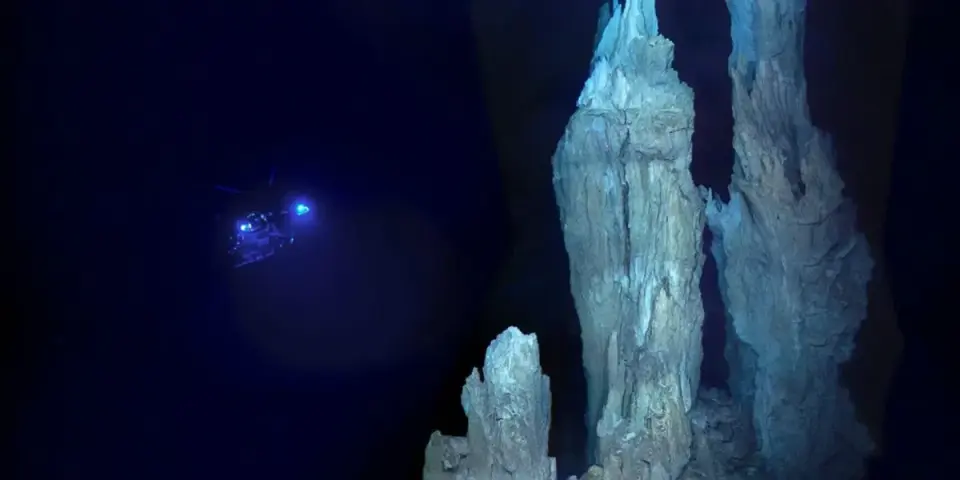
A unique hydrothermal field in the Atlantic, known as the 'Lost City,' features towering carbonate structures and supports life without sunlight. Discovered in 2000, it is the longest-lived venting environment on Earth. While it offers insights into potential life on other planets, it faces threats from deep-sea mining rights granted to Poland in 2018. Conservationists are calling for World Heritage status to protect the site.
Key points
- The 'Lost City' is a hydrothermal field located west of the Mid-Atlantic Ridge, featuring structures over 60 meters tall.
- It is the longest-lived venting environment known, active for over 120,000 years, and supports microbial and animal life without sunlight.
- The site produces hydrocarbons through chemical reactions, offering a model for how life might exist on moons like Enceladus or Europa.
- Poland was granted mining rights in the surrounding deep-sea area in 2018, raising concerns about potential environmental damage.
- Advocates are pushing for the site to be designated a World Heritage site to ensure its protection.
Background
Recent scientific studies have highlighted the importance of deep Earth and oceanic environments in understanding planetary systems. For instance, research published in late September 2026 suggested that Earth's mantle may contain ancient water reservoirs, challenging previous assumptions about water distribution. Additionally, long-term climate models indicate that Earth's habitability will gradually decline as the Sun brightens, emphasizing the fragility of planetary ecosystems. These findings underscore the significance of preserving unique environments like the 'Lost City,' which may hold clues to the origins of life and the potential for life beyond Earth.
Why it matters
The 'Lost City' provides a critical model for understanding how life can thrive in extreme, sunless environments, which is essential for astrobiology and the search for extraterrestrial life. Its unique geological and biological features make it a valuable site for scientific study. However, the threat of deep-sea mining highlights the tension between resource extraction and environmental conservation. Protecting such sites is crucial for preserving biodiversity and understanding the potential for life in other parts of the universe.
What to watch
Conservationists and scientists are likely to continue advocating for the 'Lost City' to be designated a World Heritage site to protect it from potential mining activities. Further research may be conducted to understand the site's biological and geological processes, potentially leading to new insights into the origins of life and the conditions necessary for life to exist. The outcome of the mining rights granted to Poland will also be closely monitored, as any development in the surrounding area could have unintended consequences for the 'Lost City.'
Want the full story? Read the original reporting
Read on Indy100 | News