
AdaptiveFlow platform screens 69 billion molecules to find nanomolar drug inhibitors
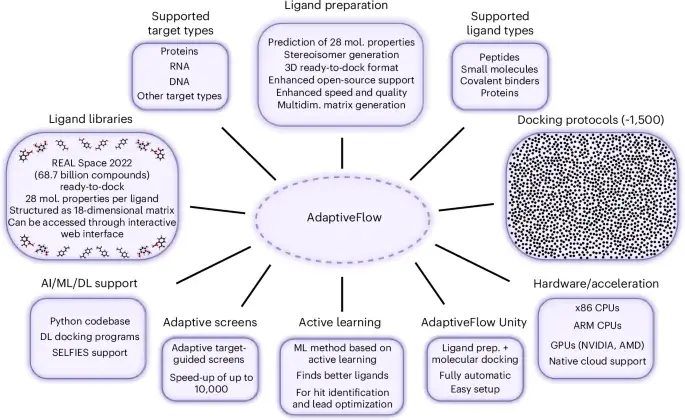
Researchers have introduced AdaptiveFlow, an open-source platform designed to make ultralarge virtual screenings (ULVSs) more efficient and accessible for drug discovery. The system integrates the Enamine REAL Space, a library of 69 billion ready-to-dock molecules, with an 18-dimensional property grid to prioritize promising chemical subspaces. By using adaptive target-guided virtual screening and optional active learning, the platform reduces computational costs by orders of magnitude while maintaining high accuracy. It supports over 1,500 docking protocols and scales near-linearly on up to 5.6 million cloud CPUs. The approach successfully identified nanomolar inhibitors for two disease-relevant targets, ferroptosis suppressor protein 1 and poly(ADP-ribose) polymerase 1, with results confirmed by co-crystal structures.
Key points
- AdaptiveFlow is an open-source platform that streamlines ultralarge virtual screenings by integrating ligand preparation, docking, and AI-driven methods.
- The platform utilizes the Enamine REAL Space, comprising 69 billion synthetically accessible molecules, organized into an 18-dimensional grid of molecular properties.
- Adaptive Target-Guided Virtual Screens (ATG-VSs) allow users to screen representative molecules from specific tranches, reducing computational effort by over 5,000-fold compared to exhaustive screening.
- The system supports over 1,500 docking protocols, including GPU-accelerated and machine learning-based methods, and scales near-linearly on 5.6 million virtual CPUs in the Amazon Web Services cloud.
- Experimental validation confirmed the discovery of nanomolar inhibitors for ferroptosis suppressor protein 1 and poly(ADP-ribose) polymerase 1, with mechanistic insights provided by co-crystal structures.
Background
This development builds on previous efforts to expand virtual screening capabilities, such as the 2025 study on rapid traversal of vast chemical space using machine learning-guided docking. It also follows earlier AI-accelerated docking studies, including a 2023 report on SARS-CoV-2 that demonstrated a 100-fold speed increase. The current work addresses the growing cost and scalability limits of traditional high-throughput screening by leveraging massive on-demand chemical libraries and cloud infrastructure.
Why it matters
By drastically reducing the computational cost and time required to screen billions of compounds, AdaptiveFlow makes advanced drug discovery more accessible to a wider range of researchers. The platform’s ability to integrate diverse docking algorithms and machine learning models accelerates the identification of potent hits for challenging targets, potentially leading to faster development of new therapies for diseases like cancer and ferroptosis-related conditions.
What to watch
The open-source nature of AdaptiveFlow and the availability of the 69-billion-molecule library in various formats, including SELFIES, will likely encourage further development of AI-driven methods for structure-based drug discovery. Researchers may explore the unoccupied regions of the chemical space identified by the 18-dimensional matrix to design novel molecules for previously undruggable targets. Future studies may also expand the use of active learning cycles to refine screening strategies and improve hit rates for complex protein-protein interaction interfaces.
Want the full story? Read the original reporting
Read on Nature