
First All-Optical Photonic Time Crystal Achieved in Terahertz Range
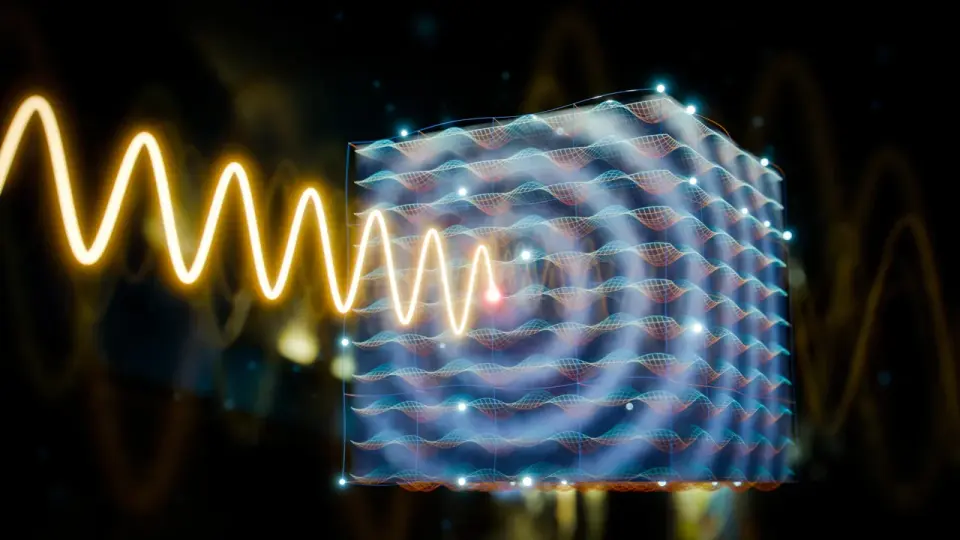
An international team has created the first all-optical photonic time crystal, a device that dynamically alters light behavior on picosecond timescales. Published in Nature, the breakthrough uses a plasmonic metamaterial and terahertz pulses to reshape optical properties, potentially enabling ultrafast computing, advanced communications, and new types of lasers.
Key points
- Researchers from École Polytechnique, Collège de France, and Helmholtz-Zentrum Dresden-Rossendorf (HZDR) successfully produced the first all-optical photonic time crystal (PTC).
- The device utilizes a plasmonic metamaterial with micrometer-scale gold structures and an indium-antimony semiconductor to trap and manipulate light.
- By applying intense terahertz pulses from HZDR's TELBE source, the team achieved rapid changes in optical properties, such as reflectivity, on a picosecond timescale.
- Theoretical models indicate that this time-based modulation reduces photon dissipation by half compared to static photonic crystals.
- The technology aims to bridge the gap between electronic and photonic speeds, potentially leading to ultrafast optical computers and highly tunable terahertz lasers.
Background
This development follows recent advancements in manipulating light through time-modulated media. In July 2026, researchers demonstrated rotational super-radiance in photonic rings using Floquet rotation, while earlier in the month, a tabletop black hole analogue revealed Hawking radiation in photonic fibers. These studies, along with 2025 breakthroughs in quantum terahertz detection and 6G communication research, highlight a growing trend in using dynamic optical structures to control electromagnetic waves for next-generation technologies.
Why it matters
Controlling light on picosecond timescales could revolutionize data processing and communication speeds. By extending photonic crystals from spatial to temporal dimensions, this technology offers a path to overcoming current limitations in optical switching and amplification, potentially enabling faster, more adaptable, and energy-efficient optical systems for medical imaging and telecommunications.
What to watch
The research team plans to further reduce photon dissipation and increase the number of photons held within the crystal to achieve stronger amplification. Success in this area could lead to the development of highly adaptable lasers and practical applications in ultrafast optical computing and advanced telecommunications within the terahertz frequency range.
Want the full story? Read the original reporting
Read on ScienceDaily