
Astrolab’s FLIP rover targets January lunar landing as Southern California aerospace sector surges
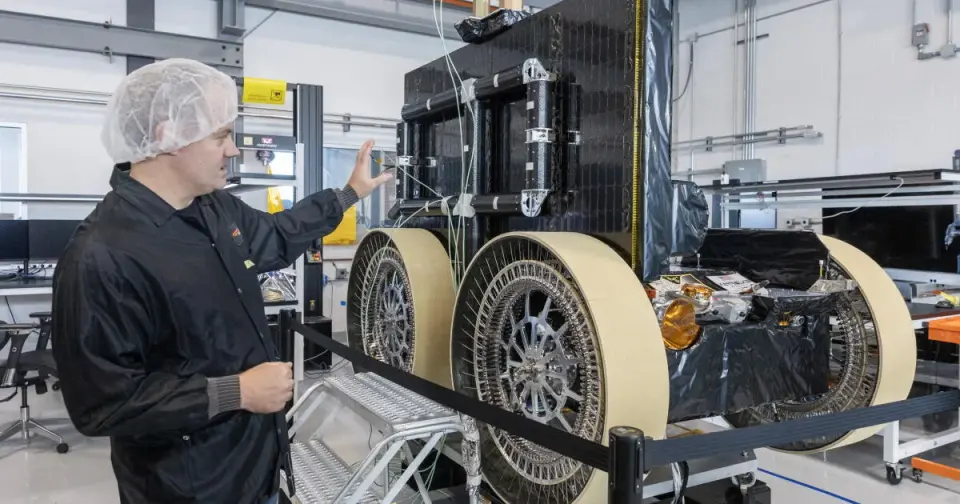
Astrolab’s semi-autonomous FLIP rover is set to launch in January 2027, aiming to be the first U.S. rover on the Moon since 1972. This mission highlights a broader resurgence in Southern California’s aerospace industry, driven by NASA’s Artemis program and private sector investments in lunar infrastructure.
Key points
- Astrolab’s FLIP rover, a $50 million demonstration vehicle, is scheduled to land on the Moon’s south pole in January 2027 via the Griffin-1 mission.
- The rover will test autonomous navigation, solar power, and thermal management in extreme lunar temperatures ranging from 103°F to -400°F.
- Southern California is experiencing an aerospace renaissance, with companies like L3Harris, Cislune, and Vast securing contracts for NASA’s Artemis program and lunar base construction.
- NASA’s new 'Ignition' roadmap outlines a phased approach to lunar presence, including frequent robotic landings and the cancellation of the Gateway station.
- The region’s aerospace sector is benefiting from a new space race involving the U.S., China, India, and Japan, with NASA expected to spend over $100 billion on lunar return and base construction.
Background
This development follows recent news that NASA opened applications for its 25th astronaut class to support the 2028 lunar return and future Mars missions. The agency is actively recruiting to address a staffing shortage as it expands operations, with successful candidates undergoing two years of training starting in 2028. The current lunar push is part of a broader strategic shift toward commercial partnerships, as seen in the Commercial Lunar Payload Services program.
How outlets are covering it
The Los Angeles Times emphasizes the economic revitalization of Southern California, highlighting how legacy suppliers and startups are benefiting from NASA’s Artemis program and private sector investments. It frames the lunar race as a new Cold War-like competition, primarily with China. In contrast, KSMU’s Astro Brief focuses on NASA’s strategic roadmap, noting the 'Ignition' plan’s emphasis on frequent robotic landings and the cancellation of the Gateway station. KSMU also highlights potential delays in SpaceX and Blue Origin’s landing systems, which could impact the timeline for crewed missions. Both sources agree on the significance of the lunar south pole but differ in their focus: the LA Times on regional economic impact, and KSMU on mission planning and international cooperation.
Why it matters
The success of the FLIP rover and the broader lunar infrastructure build-out could redefine space exploration economics, potentially leading to a $500 billion global lunar economy by 2050. It also demonstrates the viability of private sector partnerships in space, reducing risks and costs for government agencies. Furthermore, the resurgence of Southern California’s aerospace industry could create new jobs and technological advancements with applications on Earth, such as sustainability and autonomous navigation.
What to watch
The Griffin-1 mission is expected to launch in January 2027, with the FLIP rover and Voyager’s CubeRover-1 landing on the Moon. NASA’s Artemis III mission is planned for next summer, testing docking with SpaceX and Blue Origin landers. The 'Ignition' roadmap aims for frequent lunar landings every six months, with the goal of establishing a semi-habitable infrastructure by the mid-2030s. The Dragonfly mission to Titan is scheduled for 2028, with arrival in 2034.
Want the full story? Read the original reporting
Read on Los Angeles Times