
AutoDNA achieves autonomous biomolecular operations with minimal human oversight
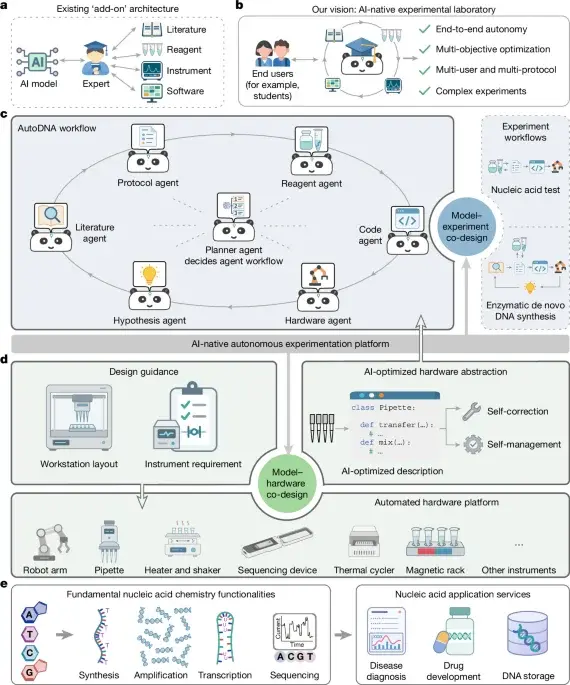
Researchers at Shanghai Jiao Tong University have developed AutoDNA, an AI-native laboratory system capable of autonomously executing complex biomolecular tasks. The platform orchestrates over 20 instruments across more than 11,000 steps to perform synthesis, transcription, amplification, and sequencing with minimal human intervention. In testing, the system matched expert-optimized enzymatic DNA synthesis yields, accelerated concurrent protocol execution by 3.2-fold, and successfully identified a clinically detected KRAS G13D mutation. Human involvement is limited to hardware maintenance, such as replenishing reagents and labware. This advancement represents a significant step toward 'science-as-a-service,' enabling end-to-end automation in biological discovery and information storage.
Key points
- AutoDNA is an AI-native autonomous laboratory designed for multi-objective biomolecular engineering.
- The system coordinates over 20 types of instruments across more than 11,000 operational steps.
- Human intervention is restricted to hardware maintenance tasks like reagent and labware replenishment.
- The platform achieved a 3.2-fold acceleration in concurrent protocol execution compared to sequential methods.
- AutoDNA successfully completed an end-to-end DNA data storage cycle with exact recovery of digital content.
- The system identified and validated a clinically detected KRAS G13D mutation in cancer detection tests.
Background
Previous developments in autonomous laboratory systems, such as the AI agent platform reported in September 2026, focused on coordinating disparate laboratory devices and robotic arms to streamline workflows. However, these earlier systems often remained confined to singular objectives or simple instrumentation. AutoDNA advances this by providing a global understanding of experiments through co-design of models, experiments, and instruments, moving beyond 'add-on' AI architectures to a fully integrated autonomous framework.
Why it matters
AutoDNA establishes a blueprint for 'science-as-a-service,' significantly accelerating biological discovery and synthetic biology applications. By automating complex nucleic acid operations with minimal human oversight, it reduces manual labor and increases the efficiency of experimental processes. This capability could transform how scientific research is conducted, enabling faster validation of clinical mutations and more reliable DNA data storage, while addressing the limitations of previous autonomous systems that lacked global experimental understanding.
What to watch
The research team has made the AutoDNA code and data available on GitHub and Zenodo for further development and verification. Future applications may expand into broader synthetic biology and information storage domains, leveraging the system's ability to handle multi-user frameworks and concurrent experiment requests. The integration of AI with hardware maintenance tasks suggests a trajectory toward fully self-sustaining laboratory environments.
Want the full story? Read the original reporting
Read on Nature