
Caltech robot completes first autonomous structure assembly in orbit
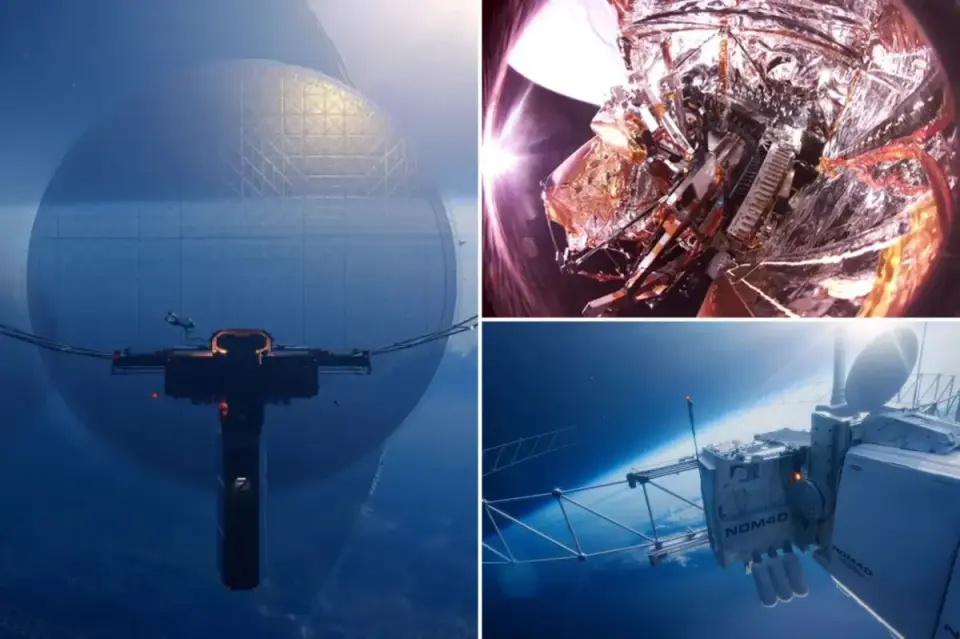
A robotic system developed by Caltech has successfully assembled a structural section in low Earth orbit for the first time, marking a milestone in autonomous space construction. The demonstration, part of DARPA’s NOM4D program, proved that large structures can be built from raw materials in orbit rather than being folded or manually assembled by astronauts. Although the mission did not complete the full antenna due to technical challenges, it validated the feasibility of scaling construction to kilometer-sized structures for future telescopes and solar arrays.
Key points
- Caltech’s ASTRA robot autonomously assembled a 1.4-meter-diameter reflector antenna in orbit using composite fiber tubes, aluminum joints, and Kapton film.
- The mission, funded by DARPA’s NOM4D program, launched on March 30, 2026, aboard SpaceX’s Transporter-16 rideshare mission hosted by Momentus Inc.
- The robot operated with limited ground communication windows, successfully building initial truss sections but failing to complete the full structure due to time constraints.
- The demonstration validates a new approach for constructing large-scale space systems, potentially enabling future telescopes, solar arrays, and communication antennas.
- DARPA aims to scale this technology to structures hundreds of meters or kilometers in size, which cannot be pre-built on Earth or unfolded in space.
Background
This development follows earlier coverage of the same milestone, confirming the significance of the first autonomous in-space assembly. The NOM4D program, initiated in 2022, seeks to enable efficient, scalable construction of very large structures in space, addressing limitations of current launch vehicle fairing sizes.
How outlets are covering it
Caltech and DARPA emphasize the technical success and scalability of the ASTRA demonstration, highlighting its potential for future space infrastructure. Space.com notes the broader implications for satellite megaconstellations and space startups, while also acknowledging the incomplete nature of the build. The New York Post focuses on the breakthrough aspect, framing it as a step toward large-scale space systems. All sources agree on the milestone’s significance but differ in emphasis: Caltech and DARPA stress engineering validation, while Space.com highlights commercial and industry impacts.
Why it matters
This achievement validates a new method for constructing large structures in space, overcoming size limitations of current launch vehicles. It could enable future telescopes, solar power arrays, and communication systems, reducing reliance on ground-based assembly and manual astronaut work. The success of the ASTRA demonstration paves the way for more ambitious space manufacturing projects, potentially transforming how we build and operate in orbit.
What to watch
DARPA’s NOM4D program will continue with a University of Illinois Urbana-Champaign project at the International Space Station, testing composite material processing in space. Caltech plans to refine the ASTRA design based on lessons learned, aiming for more complete and efficient assemblies in future missions. The broader goal is to develop scalable, automated construction methods for large-scale space systems.
- Robot builds structure in space for the first time in technological breakthrough New York Post
- Caltech Robotic Space Demo Successfully Builds in Space Caltech
- A robot just built a structure autonomously in space for the 1st time ever Space
- NOM4D program demonstrates automated in-space assembly darpa.mil
- A robot just built a structure in space for the first time New Atlas
Want the full story? Read the original reporting
Read on New York Post