
Dragonfly: The Final Frontier for NASA's Planetary Science
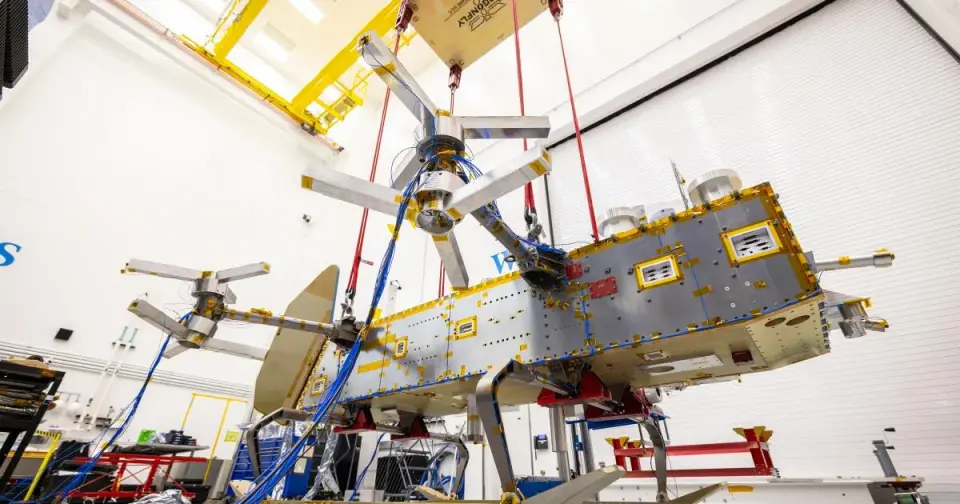
NASA’s Dragonfly rotorcraft, a $3.3 billion nuclear-powered spacecraft, is scheduled to launch in July 2028 to explore Saturn’s moon Titan. After a six-and-a-half-year cruise, it will arrive in late 2034 to fly autonomously across Titan’s surface, analyzing complex organic chemistry and habitability. The mission is now NASA’s last major planetary science project following significant budget cuts that have stalled other missions.
Key points
- Dragonfly is a car-sized, eight-rotor spacecraft powered by a plutonium-238 radioisotope thermoelectric generator, designed to fly in Titan’s dense atmosphere.
- The mission will launch on a SpaceX Falcon Heavy from Kennedy Space Center, with a target window of July 5–25, 2028.
- Upon arrival in late 2034, the craft will spend up to 40 months visiting 20 to 30 sites, covering approximately 115 kilometers to study prebiotic chemistry.
- Dragonfly is the final large-scale planetary mission for NASA, as funding cuts have halted projects to Uranus, Venus, and Enceladus.
- The spacecraft will use autonomous navigation for entry and landing due to the significant communication delay between Earth and Titan.
Background
Dragonfly’s development began in 2000 as a speculative concept by Ralph Lorenz. Over the past two decades, the mission has faced schedule delays due to funding constraints, the pandemic, and supply-chain issues. Previous coverage highlighted the technical challenges of operating in Titan’s frigid environment, where water is solid and methane acts as liquid. The mission is a successor to the Cassini/Huygens probe, which landed on Titan in 2005 but operated for only 72 minutes.
How outlets are covering it
The Los Angeles Times emphasizes the mission's status as a 'survivor' in a landscape of reduced NASA funding, highlighting the personal stakes for the team led by Ralph Lorenz and Elizabeth Turtle. Space Daily provides a technical deep-dive, noting that while the launch date is a target window, the six-and-a-half-year cruise is a fixed physical reality. It stresses that Dragonfly is a 'flying laboratory' designed to compare different terrains, unlike stationary landers. Tech Briefs offers a more concise overview, focusing on the engineering aspects of the dual-quadcopter design and the autonomous nature of the mission. All sources agree on the scientific goal: investigating habitability and complex organics rather than directly searching for life, which is considered unlikely on the surface due to extreme cold.
Why it matters
Dragonfly represents the culmination of NASA’s current planetary science strategy. With other missions stalled by budget cuts, this mission is the agency's last major opportunity to explore a new world in the coming decade. Its success will determine the future of deep-space exploration and provide critical data on prebiotic chemistry in an environment unlike Earth.
What to watch
Technicians at Johns Hopkins University Applied Physics Laboratory are currently installing rotors and scientific instruments. The spacecraft is expected to be completed in the coming months, followed by a launch in July 2028. The first data from Titan is not expected until late 2034, after a six-and-a-half-year cruise.
- NASA’s nuclear Dragonfly copter to search for signs of life on Titan: ‘A lot’s riding on it’ Los Angeles Times
- NASA's Dragonfly rotorcraft will launch on a SpaceX Falcon Heavy in July 2028 and spend six and a half years crossing the solar system to land on a moon that has weather, seasons, rivers and seas — with methane and ethane flowing across its surface inste Space Daily
- NASA Prepares to Fly on Saturn's Moon with Dragonfly Tech Briefs
- Dragonfly: NASA’s Most Exciting Mission This Century Is Taking Shape Forbes
Want the full story? Read the original reporting
Read on Los Angeles Times