
NASA's Dragonfly: A Nuclear Rotorcraft to Probe Titan's Prebiotic Chemistry
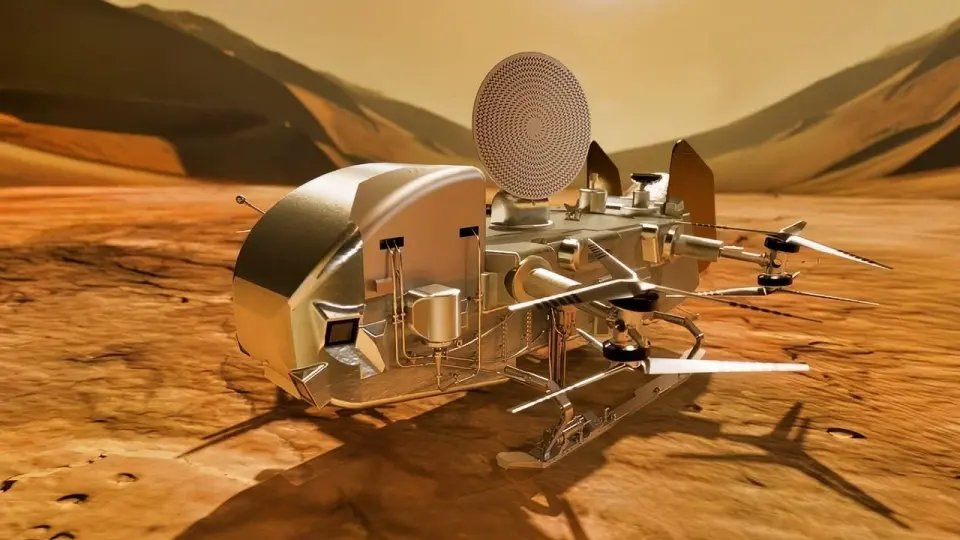
NASA's Dragonfly mission, a $3.3 billion nuclear-powered rotorcraft, is scheduled to launch in July 2028 and arrive at Saturn's moon Titan in late 2034. The car-sized drone will fly autonomously across Titan's dense atmosphere to analyze complex organic compounds, testing whether prebiotic chemistry is a universal planetary process rather than an Earth-specific anomaly.
Key points
- Dragonfly is an eight-rotor, 875-kilogram aircraft powered by a Multi-Mission Radioisotope Thermoelectric Generator (MMRTG) using plutonium-238.
- The mission will launch on a SpaceX Falcon Heavy from Kennedy Space Center, with a firm-fixed-price contract of approximately $256.6 million.
- Titan's dense atmosphere (four times Earth's density) and low gravity (one-seventh of Earth's) allow for efficient aerodynamic lift, enabling the craft to hop between multiple sites.
- The primary scientific goal is to investigate prebiotic chemistry and organic molecular pathways, not to detect biological life, using instruments like the Dragonfly Mass Spectrometer (DraMS).
- The spacecraft will operate autonomously due to the significant communication delay between Earth and Titan, navigating hazards and selecting landing sites without real-time human control.
Background
Dragonfly has been in development for over a decade, surviving budget uncertainties and shifting NASA priorities. It is currently the last large-scale planetary science mission in NASA's pipeline, following the recent launch of the Nancy Grace Roman space telescope. Previous missions, such as Cassini and Huygens, provided initial data on Titan, but Dragonfly represents a shift from stationary landers to mobile aerial exploration.
How outlets are covering it
While 19FortyFive emphasizes the technological novelty of aerial exploration and the 'chemistry laboratory' aspect of Titan, the Los Angeles Times highlights the mission's status as a 'survivor' of federal budget cuts and its role as a final major planetary project. Space Daily provides a technical focus on the launch logistics and the physical advantages of Titan's environment for flight. All sources agree that the mission is primarily focused on prebiotic chemistry rather than the detection of life, though the LA Times notes a remote possibility of life in a subsurface ocean.
Why it matters
Dragonfly serves as a benchmark for future planetary exploration, demonstrating that aerial vehicles can bypass the limitations of wheeled rovers. Its findings on organic chemistry could determine if complex molecular structures are a common consequence of planetary physics, with implications for astrobiology beyond our solar system.
What to watch
The spacecraft is currently being assembled at the Johns Hopkins University Applied Physics Laboratory. The next major milestone is the launch window in July 2028, followed by a six-and-a-half-year cruise to Titan, with arrival expected in December 2034.
- 8 Years from Now, NASA Will Send a Nuclear-Powered Helicopter Into Titan's Atmosphere Where It Rains Methane 19FortyFive
- NASA’s nuclear Dragonfly copter to search for signs of life on Titan: ‘A lot’s riding on it’ Los Angeles Times
- Dragonfly: NASA’s Most Exciting Mission This Century Is Taking Shape Forbes
- NASA's Dragonfly rotorcraft will launch on a SpaceX Falcon Heavy in July 2028 and spend six and a half years crossing the solar system to land on a moon that has weather, seasons, rivers and seas — with methane and ethane flowing across its surface inste Space Daily
Want the full story? Read the original reporting
Read on 19FortyFive