
Engineered Peptide Nanopores Detect Parkinson’s Biomarkers with Nanomolar Precision
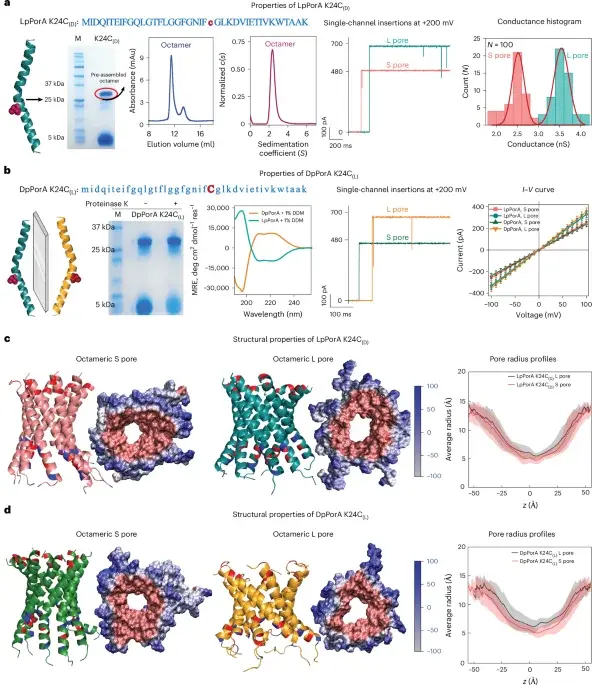
Researchers have developed a self-assembling peptide nanopore system capable of detecting disease biomarkers with high sensitivity. The system uses a single peptide, pPorA, which forms octameric structures in lipid membranes. By incorporating unnatural amino acids, scientists created two distinct pore sizes with conductances of 2.4 nS and 3.5 nS. These pores can detect intrinsically disordered proteins, including alpha-synuclein variants linked to Parkinson’s disease, with nanomolar affinity. The technology allows for the differentiation of protein aggregates and the monitoring of aggregation pathways in real-time.
Key points
- The pPorA peptide self-assembles into stable octameric alpha-helical nanopores within lipid bilayers.
- Strategic incorporation of unnatural amino acids creates small and large diameter pores with distinct conductances of 2.4 nS and 3.5 nS in 1 M KCl.
- Large pores detect alpha-synuclein variants, including a pathogenic Parkinson’s-associated mutant, with a dissociation constant of approximately 20 nM.
- The system resolves time-dependent aggregation pathways, distinguishing between monomers, toxic oligomers, and fibrils.
- Small pores detect smaller peptides associated with apoptosis and amyotrophic lateral sclerosis, demonstrating tunable sensing capabilities.
Background
This development builds on recent advances in nanopore technology, including programmable antimicrobial peptides and single-residue sequencing methods. While previous studies focused on antimicrobial applications or sequencing, this research emphasizes the detection of complex disease biomarkers. The ability to distinguish between different protein conformations addresses a significant challenge in diagnosing neurodegenerative diseases, where proteins often exist in heterogeneous states. This work extends the utility of alpha-helical nanopores beyond simple molecular sensing to the profiling of dynamic biological processes.
Why it matters
This technology offers a potential breakthrough in early diagnosis and monitoring of neurodegenerative diseases like Parkinson’s. By detecting specific protein variants and their aggregation states with high sensitivity, these nanopores could enable earlier intervention and more precise tracking of disease progression. The tunable nature of the pores suggests broad applicability for other protein-based biomarkers, potentially improving diagnostic accuracy and reducing reliance on less sensitive conventional methods.
What to watch
Future research will likely focus on validating these nanopore sensors in clinical samples and exploring their application to other disease-related proteins. Researchers may also investigate the stability and scalability of these self-assembled pores for commercial diagnostic devices. Additionally, further studies could examine the long-term behavior of these sensors in complex biological environments to ensure reliability for real-world medical use.
Want the full story? Read the original reporting
Read on Nature