Engineered Peptide Nanopores Detect Parkinson’s Biomarkers with Nanomolar Precision
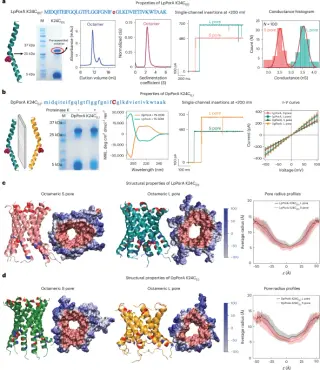
Researchers have developed a self-assembling peptide nanopore system capable of detecting disease biomarkers with high sensitivity. The system uses a single peptide, pPorA, which forms octameric structures in lipid membranes. By incorporating unnatural amino acids, scientists created two distinct pore sizes with conductances of 2.4 nS and 3.5 nS. These pores can detect intrinsically disordered proteins, including alpha-synuclein variants linked to Parkinson’s disease, with nanomolar affinity. The technology allows for the differentiation of protein aggregates and the monitoring of aggregation pathways in real-time.