
DynaVelo Model Predicts B Cell Fate Shifts and Rescue Targets from Single-Cell Multiome Data
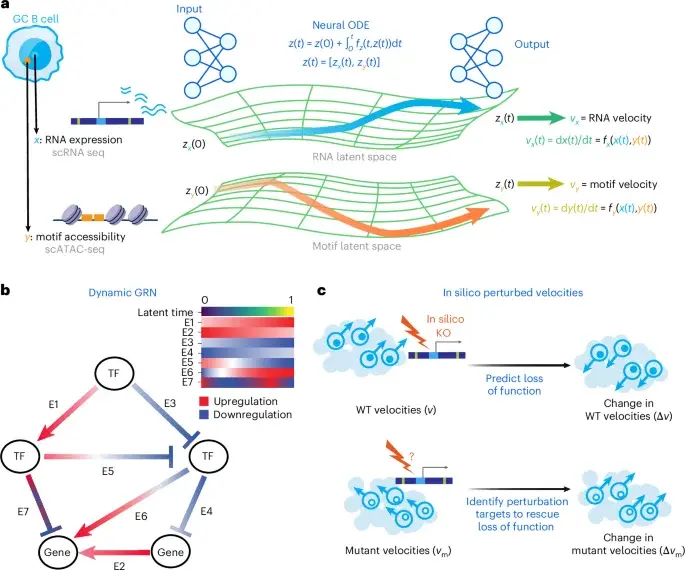
Researchers developed DynaVelo, a generative neural ordinary differential equation model that integrates single-cell RNA and chromatin accessibility data to simulate B cell dynamics. The model accurately predicts how heterozygous loss of epigenetic regulators Arid1a and Ctcf disrupts germinal center trajectories, specifically causing premature exit from the dark zone. By performing in silico perturbations, DynaVelo identified Ctcf, Stat3, and Bcl6 as potential rescue targets. In vivo experiments confirmed that double-heterozygous deletions of these targets restored wild-type dynamics, validating the model’s predictive power for gene regulatory networks.
Key points
- DynaVelo jointly models gene expression and transcription factor motif activity to infer cell dynamics from single-snapshot multiome data.
- The model captures complex germinal center B cell trajectories, including the recirculation of centrocytes back to the dark zone, which is lost in Arid1a and Ctcf mutants.
- In silico perturbation of Arid1a mutants identified Ctcf, Stat3, and Bcl6 as key targets to rescue the disrupted phenotype.
- Experimental validation in double-heterozygous mice confirmed that perturbing these targets restored wild-type dynamics and corrected the dark-zone/light-zone ratio.
- DynaVelo outperforms existing methods like scVelo and MultiVelo by providing a functional vector field that allows for intervention, not just trajectory visualization.
Background
Recent advancements in single-cell technologies have enabled the simultaneous measurement of transcriptomic and epigenomic data, yet inferring dynamic cellular processes from static snapshots remains challenging. Previous models, such as scVelo and MultiVelo, estimate RNA velocities but lack the functional form required to simulate perturbations or predict rescue outcomes. DynaVelo addresses this gap by integrating neural ordinary differential equations with multiomic data, offering a generative framework for understanding how epigenetic regulators influence cell fate decisions in immune cells.
Why it matters
This study provides a computational framework for predicting the effects of genetic perturbations on cell fate without requiring extensive experimental trials. By identifying rescue targets for loss-of-function mutations in epigenetic regulators, DynaVelo offers a potential pathway for therapeutic interventions in B cell lymphomas, where Arid1a is commonly altered. The ability to simulate dynamic gene regulatory networks from single-snapshot data could accelerate the discovery of biomarkers and treatment strategies for immune disorders.
What to watch
Researchers will likely expand DynaVelo’s application to other cell types and disease contexts, particularly those involving rapid and complex dynamics driven by transcription factors. Further validation of the identified rescue targets in human patient-derived models and clinical settings will be crucial to determine the model’s translational potential. Additionally, integrating additional modalities, such as 3D chromatin interactome data, may enhance the model’s accuracy in predicting long-range regulatory interactions.
Want the full story? Read the original reporting
Read on Nature