
Engineered Avian Retrotransposons Achieve 60% Targeted Gene Integration in Human Cells
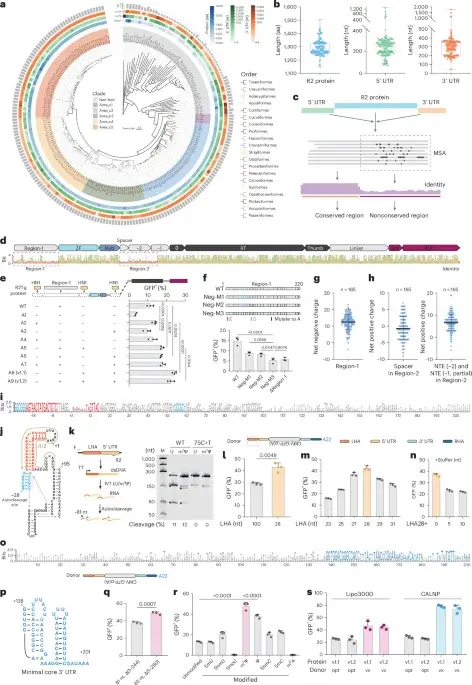
Researchers at the Beijing Institute of Genomics identified 159 new avian R2 retrotransposons by scanning 1,139 bird genomes. By engineering these elements, they created an all-RNA system that achieves up to 60% site-specific gene integration in human primary cells, offering a new tool for precise genome editing without double-strand DNA breaks.
Key points
- A team led by Wei Li and colleagues screened 1,139 avian genomes to discover 159 previously unknown R2 retrotransposons, expanding the known resource for genomic integration.
- The researchers characterized conserved and non-conserved features in the proteins and untranslated region elements of these retrotransposons to guide engineering efforts.
- Engineered variants of these avian R2 retrotransposons demonstrated robust activity, achieving up to 60% site-specific gene integration in human primary cells.
- This all-RNA-mediated approach provides an alternative to nuclease-based methods, potentially reducing the risks associated with double-strand DNA breaks in therapeutic applications.
- Sequencing data from the study has been deposited in the Genome Sequence Archive for Human under accession number HRA013312, with analytic code available on GitHub.
Background
This discovery builds on recent advances in precise genome editing, such as prime assembly, which allows for the integration of large DNA fragments in non-dividing cells. While previous R2 retrotransposon studies focused on Drosophila or specific engineered variants, this work broadens the toolkit by mining avian genomes for new orthologs. The development of all-RNA systems aims to improve the safety and efficiency of gene therapy by avoiding the immunogenic and mutagenic risks often associated with traditional CRISPR-Cas9 nuclease approaches.
Why it matters
The ability to integrate genes site-specifically using all-RNA systems in primary human cells is a significant step toward safer and more efficient gene therapies. High integration efficiency in primary cells, which are difficult to manipulate, suggests these tools could be applied to treat genetic disorders or enhance immune cells for cancer therapy without the off-target effects common in current editing platforms.
What to watch
Researchers will likely test the long-term stability and functional expression of integrated genes in these engineered systems. Further studies may explore the application of these avian R2 variants in other cell types or for therapeutic gene delivery in vivo, building on the foundational work published in Nature Biotechnology.
Want the full story? Read the original reporting
Read on Nature