
Iron Catalysts Use Hydrogen Bonds to Convert Nitrate Pollution into Ammonia
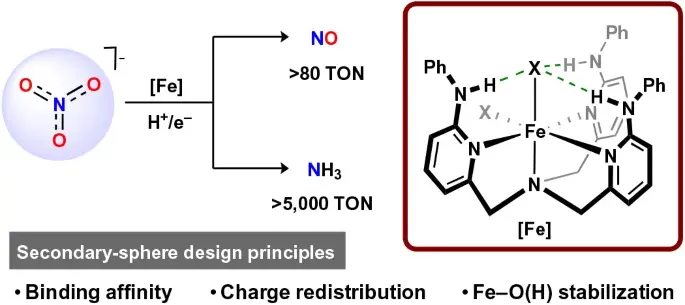
University of Michigan researchers have developed a bioinspired iron catalyst that uses secondary-sphere hydrogen bonds to bind and reduce nitrate, a persistent groundwater pollutant. By mimicking biological nitrate transport proteins, the catalyst achieves up to seven orders of magnitude higher binding affinity for nitrate compared to non-hydrogen-bonding analogues. This activation allows for the catalytic reduction of nitrate into nitric oxide under thermal conditions or ammonia under photochemical conditions, offering a potential pathway for converting environmental pollutants into useful fertilizers.
Key points
- The study, led by Nathaniel Szymczak at the University of Michigan, introduces a ligand scaffold with appended aniline hydrogen-bond donors to enhance nitrate binding.
- Zinc-based complexes with these hydrogen bonds show a binding affinity for nitrate that is 10 million times stronger than those lacking such interactions.
- Replacing zinc with redox-active iron enables the reduction of nitrate, producing nitric oxide (NO) via heat or ammonia (NH3) via light.
- The mechanism involves charge redistribution within the nitrate ion, weakening nitrogen-oxygen bonds and facilitating deoxygenation.
- The approach addresses the challenge of nitrate's chemical inertness, which typically requires high energy input for reduction.
Background
Nitrate contamination in groundwater is a major environmental issue caused by agricultural fertilizer runoff, leading to eutrophication and health risks. Previous remediation methods, such as ion exchange, generate waste, while chemical reduction is energy-intensive due to nitrate's stability. This work builds on earlier findings regarding iron's role in biological and synthetic systems, including recent studies on gut bacteria converting dietary nitrate and iron into health-beneficial molecules, and the potential of iron-rich minerals in green hydrogen production. The current research focuses on fundamental catalytic principles rather than immediate deployment, aiming to establish design rules for future environmental technologies.
How outlets are covering it
The primary source, Nature, emphasizes the mechanistic details, highlighting how secondary-sphere hydrogen bonds induce charge redistribution and orbital changes in nitrate, enabling reduction. It notes that while hydrogen bonds enhance binding, the primary driver for spontaneous reduction is the stabilization of intermediates. The secondary source, Bioengineer.org, frames the discovery as a solution to a global pollution crisis, emphasizing the potential for a circular nitrogen economy where nitrate is recovered and reused as fertilizer. It highlights the practical implications and the inspiration from biological enzymes, whereas the primary source focuses on the fundamental chemical principles and the specific role of the iron complex in overcoming nitrate's inertness.
Why it matters
This research provides a new strategy for remediating nitrate pollution, a widespread environmental problem. By mimicking biological systems, the catalyst offers a more efficient and potentially lower-energy method for reducing nitrate compared to traditional approaches. The ability to convert nitrate into ammonia, a valuable fertilizer, suggests a pathway for sustainable nitrogen management, turning a pollutant into a resource. This could have significant implications for water treatment and agricultural sustainability.
What to watch
The next steps involve translating these fundamental principles into practical, scalable systems for nitrate removal from wastewater and groundwater. Researchers will likely focus on optimizing the catalyst for real-world conditions, improving turnover numbers, and developing devices that can operate continuously. The study also opens avenues for exploring other redox-active metals and ligand designs to enhance catalytic efficiency and selectivity.
- Secondary-sphere hydrogen bonding promotes catalytic nitrate reduction at iron Nature
- Iron complex breaks down stubborn pollutant using light-powered reaction Phys.org
- Chemists Harness Hydrogen Bonds to Break Down Persistent Nitrate Pollution Bioengineer.org
- Forging ammonia with iron and light from water and nitrogen Nature
Want the full story? Read the original reporting
Read on Nature