
Magnetic Field Tuning of Exciton-Polariton Condensates in CrSBr Microwires
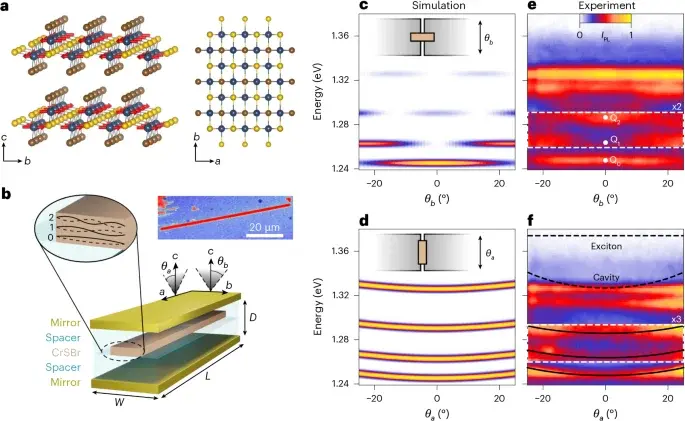
Researchers demonstrated that exciton-polariton condensates in chromium sulfide bromide (CrSBr) microwires can be magnetically tuned by up to 10.5 meV. By embedding few-nanometer CrSBr flakes in optical cavities, the team achieved polariton condensation in excited states, characterized by enhanced spatial and temporal coherence. The condensate energy shifts significantly under an external magnetic field of 2 T due to the reconfiguration of the material's spin order, transitioning from antiferromagnetic to ferromagnetic phases. This mechanism offers a new control knob for quantum light sources, distinct from traditional electric-field methods, and suggests potential applications in microwave-to-optical transduction and spintronic interfaces.
Key points
- CrSBr microwires embedded in optical cavities exhibit exciton-polariton condensation under ultrafast photoexcitation, evidenced by linewidth narrowing and intensity increases.
- The condensate energy shifts by up to 10.5 meV when an external magnetic field of 2 T is applied, driven by the reconfiguration of the spin order rather than Zeeman splitting.
- Condensation occurs in excited quantized states rather than the ground state, facilitated by resonant phonon and magnon scattering pathways from surface excitons.
- The magnetic tuning mechanism alters the exciton wavefunction from quasi-one-dimensional to three-dimensional as the material transitions from antiferromagnetic to ferromagnetic order.
- The measured coherence time exceeds the spontaneous polariton lifetime by an order of magnitude, confirming macroscopic quantum coherence.
Background
This study builds on prior research into van der Waals magnets like CrSBr, which have shown strong coupling between excitons and photons. Earlier work in 2023 explored magneto-optics and ultrastrong coupling regimes in similar materials, but this is the first demonstration of magnetic control over a polariton condensate. The findings address a long-standing challenge in quantum optics: controlling coherent condensate emission without structural modification. While superconducting condensates have seen spin-based control, exciton-polariton systems lacked analogous spin-based perspectives until now.
Why it matters
This research provides a new platform for spin-controlled coherent quantum light sources, potentially enabling magnetic-memory integration and efficient microwave-to-optical transduction for quantum information. The ability to tune condensate energy via magnetic fields, rather than electric fields, offers a distinct advantage for interfacing semiconductor optics with spintronic technologies. It opens avenues for ultrafast modulation of coherent emission through coupling to high-frequency magnons, advancing the development of next-generation quantum devices.
What to watch
Future work may focus on modulating coherent condensate emission on ultrafast timescales by coupling it to coherent, high-frequency magnons. Researchers will likely explore the integration of these magnetic-memory interfaces and efficient microwave-to-optical transduction for quantum information purposes, where microwave photons couple to condensate emission via magnons.
Want the full story? Read the original reporting
Read on Nature