
DNA Origami Nanosyringe Enables Programmable Membrane Penetration and Reversible Cargo Delivery
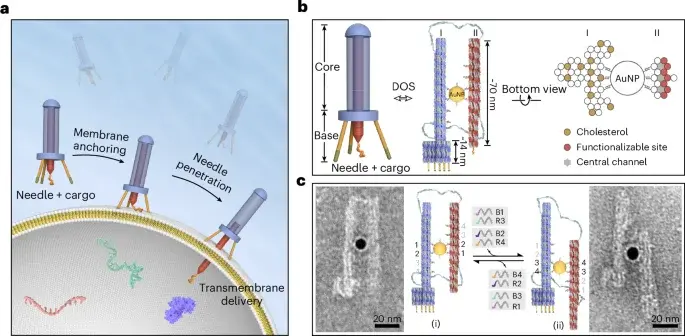
Researchers have developed a programmable DNA origami nanosyringe that mimics bacterial contractile injection systems to deliver molecular cargo across lipid membranes. The device uses DNA fuel to drive a needle-like structure through cell membranes in precise 14-nanometer steps, allowing for controlled penetration and subsequent retraction. This system enables the transport of small molecules via passive diffusion and larger biomolecules via active mechanical translocation, facilitating on-demand biochemical reactions within synthetic cells.
Key points
- The nanosyringe consists of two 70-nm DNA origami bundles crosslinked by a 10-nm gold nanoparticle, with one bundle acting as a cholesterol-anchored base and the other as a sliding needle.
- DNA fuel strands trigger reversible sliding, allowing the needle to penetrate membranes and then retract to reseal the lipid bilayer, a feature distinct from permanent nanopore insertions.
- The device supports two transport modes: passive diffusion of small molecules through central channels and active translocation of tethered macromolecules via the needle tip.
- Experimental results demonstrate the nanosyringe’s ability to initiate hybridization chain reactions, RNA transcription, and catalytic RNA cleavage within giant unilamellar vesicles.
- Membrane penetration efficiency is influenced by mechanical resistance, with higher resistance membranes proving more difficult to penetrate, while the system maintains integrity upon needle retraction.
Background
This development builds on recent advances in structural DNA nanotechnology, which has previously produced motors, turbines, and force-generating actuators. While natural systems like bacterial contractile injection systems offer efficient transmembrane delivery, they are difficult to engineer due to complex activation mechanisms. Synthetic DNA devices offer modularity and rational design, bridging the gap between nanoscale engineering and biological function. Previous work in DNA nanotechnology has focused on membrane remodeling and signal transduction, but this study introduces a dynamic, actuated system for directed translocation.
Why it matters
This technology provides a scalable, signal-responsive alternative to manual microneedle techniques used in procedures like intracytoplasmic sperm injection. By enabling precise, on-demand control of molecular transport and biochemical reactions within cell-sized compartments, the nanosyringe could revolutionize therapeutic delivery, synthetic biology, and molecular diagnostics. Its ability to operate at membrane interfaces with high spatiotemporal precision offers a pathway for developing advanced nanomedicines that can bypass biochemical transport constraints.
What to watch
Future research will likely focus on expanding the cargo delivery scope beyond DNA-tethered biomolecules by developing alternative tethering chemistries. Researchers may also explore the application of these nanosyringes in living cells to test their efficacy in complex biological environments. Additionally, further optimization of membrane penetration efficiency across various lipid compositions and mechanical resistances could enhance the device’s versatility for diverse therapeutic and diagnostic applications.
Want the full story? Read the original reporting
Read on Nature