
Nanjing researchers achieve single-amino-acid peptide sequencing via nanopore enzymatic digestion
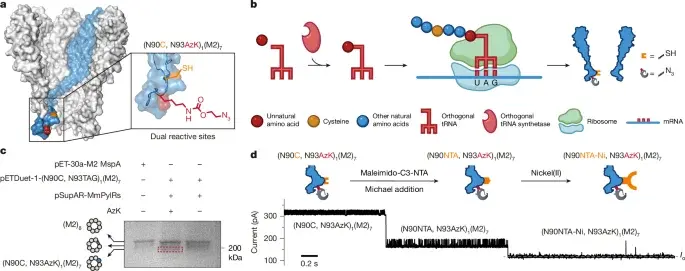
A new nanopore method called transient pore analyte looping (tPAL) enables the precise, stepwise reading of peptide sequences by immobilizing them on an engineered MspA pore and using an enzyme to shorten them one amino acid at a time. Developed by researchers at Nanjing University, this technique achieves single-amino-acid resolution, allowing for the detection of mutations, post-translational modifications, and unnatural amino acids, which addresses a major challenge in proteomics.
Key points
- Researchers at Nanjing University developed a nanopore-based strategy named transient pore analyte looping (tPAL) for peptide sequencing.
- The method uses an engineered Mycobacterium smegmatis porin A (MspA) nanopore modified with a nickel-ion-bound adapter to immobilize target peptides.
- A cholesterolized aminopeptidase enzyme sequentially shortens the immobilized peptide by single amino acids, generating distinct electrical signals for each step.
- The technique achieves single-amino-acid resolution, enabling the identification of single-amino-acid mutations and post-translational modifications.
- The approach also detects unnatural amino acid insertions, demonstrating versatility in chiral peptide analysis and proteomics.
- Machine learning algorithms are used to decode the sequence-dependent signal alterations generated during the sequential cleavage process.
Background
Accurate peptide sequence decoding is a longstanding challenge in proteomics due to the complexity of protein structures. While nanopore sequencing has revolutionized nucleic acid analysis, applying it to peptides has been difficult due to inconsistent signal generation. Previous studies, including work by Dekker and others, have explored single-molecule protein sequencing, but achieving narrow, consistent, and sequence-dependent events for peptides remained a technical hurdle. This new study builds on earlier nanopore advancements, such as the discrimination of all 20 proteinogenic amino acids reported in 2023 and 2024, to provide a more robust solution for peptide analysis.
Why it matters
This advancement provides a potential alternative to mass spectrometry for peptide sequencing, offering a method that can detect subtle changes like single-amino-acid mutations and post-translational modifications with high precision. The ability to identify unnatural amino acid insertions also opens possibilities for synthetic biology and pharmaceutical development. By achieving single-amino-acid resolution, this technique could enhance the accuracy of proteomic analyses, contributing to better understanding of protein function and disease mechanisms.
What to watch
The researchers have provided machine learning training data and custom code for peptide decoding as supplementary materials. Future work will likely focus on scaling this technology for high-throughput applications and integrating it with other proteomic tools. The availability of the data and code suggests a move toward open-source development in nanopore proteomics, potentially leading to broader adoption in clinical and research settings.
Want the full story? Read the original reporting
Read on Nature