
Texas A&M Unveils World’s Largest Indoor Lunar and Martian Test Facilities at Johnson Space Center
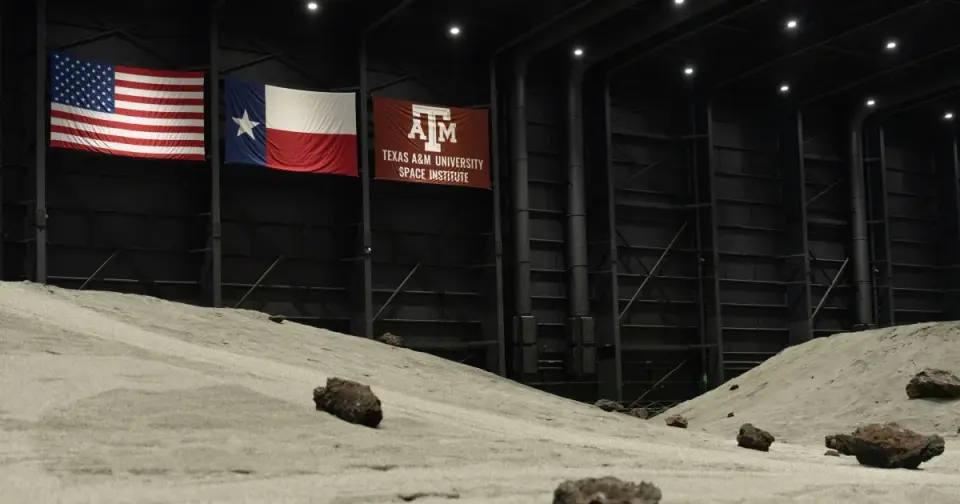
Texas A&M University has opened a new Space Institute at the Johnson Space Center in Houston, featuring the world’s largest indoor replicas of lunar and Martian terrain. Funded by a $200 million state appropriation, the facility spans the size of two football fields and supports a new space engineering degree. NASA officials describe the site as a critical upgrade for testing lunar vehicles, while university leaders emphasize its role in attracting students and advancing technology with terrestrial applications.
Key points
- The new Space Institute opened on November 20, 2026, at the Johnson Space Center in Houston.
- The facility contains the world’s largest indoor replicas of lunar and Martian landscapes, built using rock from Uvalde, Texas, and New Mexico, respectively.
- The Texas Legislature allocated $200 million to fund the construction of the institute.
- The university launched a new space engineering degree program, citing the facility as a unique 'living, learning laboratory' to attract students.
- NASA’s moon base program manager, Carlos Garcia-Galan, stated the facility is a significant improvement over current 'rock yards' used for testing lunar terrain vehicles.
Background
This development follows recent NASA initiatives to prepare for lunar and Martian missions, including the opening of applications for the 25th astronaut class in November 2026. The agency is actively seeking candidates to support the 2028 lunar return and the construction of a moon base, highlighting the increasing urgency for advanced testing infrastructure.
How outlets are covering it
While NBC News focused on the visual scale of the new landscapes, the Bryan College Station Eagle provided minimal detail beyond the opening. ABC13 Houston offered the most comprehensive reporting, detailing the funding source, the specific materials used for the terrain replicas, and the launch of the new degree program. NASA officials emphasized the practical utility of the facility for testing lunar vehicles, noting that current testing scopes are much smaller. In contrast, Texas A&M President Susan Ballabina highlighted the educational benefits, arguing that the facility is essential for attracting students to the new space engineering program. The sources agree on the facility’s size and location but differ in emphasis, with ABC13 focusing on the legislative funding and educational impact, while NBC News highlighted the physical scale of the terrain replicas.
Why it matters
The opening of this facility marks a significant advancement in space research infrastructure in the United States. By providing a large-scale, realistic testing environment for lunar and Martian conditions, the institute aims to accelerate the development of technologies necessary for future space missions. Additionally, the facility is expected to drive innovation in terrestrial technologies, such as micro-electronics, by leveraging the research capabilities developed for space exploration. The $200 million investment also signals a strong commitment from the Texas Legislature to positioning the state as a leader in the space industry.
What to watch
NASA plans to adapt the facility as more missions to the moon are conducted, using the data gathered to refine testing procedures. The university expects to see an increase in enrollment for the new space engineering degree program, leveraging the unique resources of the Space Institute. As NASA continues to prepare for the 2028 lunar return and future Mars missions, the facility will likely become a central hub for testing and developing new technologies.
- Giant landscapes simulating the moon and Mars debut in Texas — look inside NBC News
- Texas A&M is leading the way to the stars Texas A&M Stories
- Texas A&M seeks to lead in space with new Space Institute Bryan College Station Eagle
- ‘Houston we now have a solution’: Texas A&M opens $200M Space Institute for lunar, Mars research Community Impact
- Texas A&M plants the flag on its new Space Institute ABC13 Houston
Want the full story? Read the original reporting
Read on NBC News