
Thorium-229 Nuclear Clocks Achieve Standalone Operation and Dark Matter Constraints
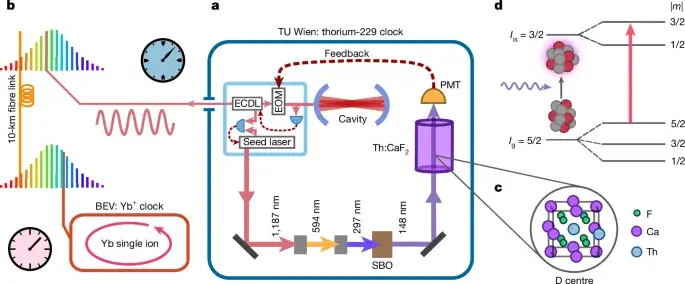
Researchers at TU Wien and Tsinghua University have demonstrated the first operational thorium-229 nuclear clocks, which use solid-state crystals to measure time with high precision. These devices match the sensitivity of leading atomic clocks for detecting dark matter and offer a more robust, compact alternative to current optical standards.
Key points
- TU Wien and Tsinghua University published the first results for standalone thorium-229 nuclear clocks in Nature on October 7, 2026.
- The clocks utilize thorium-229 doped into calcium fluoride crystals, achieving a fractional frequency instability of 3x10^-12 per second.
- The devices can operate continuously for one day without intervention, approaching 10^-15 instability over 24 hours.
- The nuclear clocks provided new constraints on ultralight dark matter, matching the sensitivity of the best atomic clocks for photon coupling and exceeding previous limits for strong force coupling.
- Current limitations include reproducibility issues due to crystal inhomogeneity, with future improvements projected to reach 10^-15 instability per second.
Background
The development of nuclear clocks builds on decades of research into the thorium-229 isomer, first theorized in 2003. Previous breakthroughs included the 2016 confirmation of the isomer's existence and 2022 optical detection of its radiative decay. Recent advances in 148-nm continuous-wave lasers and highly doped crystals in 2024-2025 enabled the current absorption spectroscopy techniques. This follows a broader trend in precision timekeeping, where atomic clocks have long served as the standard, but nuclear clocks promise greater robustness against external perturbations.
How outlets are covering it
TU Wien's Thorsten Schumm emphasizes the practical advantages of the nuclear clock, noting its potential for a 'chip-scale device' with a reduced energy footprint compared to complex atomic clock laboratories. He highlights the clock's resilience to electromagnetic interference. Tsinghua University's Shiqian Ding focuses on the technical challenges overcome, such as developing precise lasers and suitable materials, and envisions deploying this precision in navigation and space-based measurements. ABC News and Financial Times highlight the broader implications for GPS and national security, noting that while current nuclear clocks do not yet surpass the best atomic clocks in stability, they are expected to improve rapidly. The Financial Times also notes the scarcity of thorium-229 and its competing use in cancer therapy as a supply constraint.
Why it matters
The realization of a standalone nuclear clock marks a significant step toward more robust and portable precision timekeeping. This technology could enhance GPS accuracy, improve mining surveys through gravitational field measurements, and provide new tools for testing fundamental physics, such as the existence of dark matter. The ability to operate at room temperature in a solid-state format suggests future applications in mobile and space-based systems, potentially outperforming current atomic clocks in the coming years.
What to watch
Researchers plan to install a second nuclear clock in Innsbruck within a year to compare with the Vienna unit and measure subtle changes in Earth's movement. Improvements in VUV laser power and crystal homogeneity are expected to significantly boost stability. The team aims to reach a fractional frequency instability of 10^-15 per second, potentially matching state-of-the-art atomic clocks while maintaining the simplicity of a solid-state device.
- A thorium-229 optical nuclear clock with feedback loop Nature
- In Vienna and Beijing, the First Nuclear Clocks Begin to Tick The New York Times
- Scientists in Vienna and Beijing create world's first nuclear clocks Reuters
- New nuclear clocks could become world's most accurate timekeepers ABC News & Headlines – Australian Broadcasting Corporation
- Scientists unveil first ultra-accurate nuclear clocks Financial Times
Want the full story? Read the original reporting
Read on Nature