
Weizmann scientists create molecular Archimedes screw that boosts conductivity 100-fold
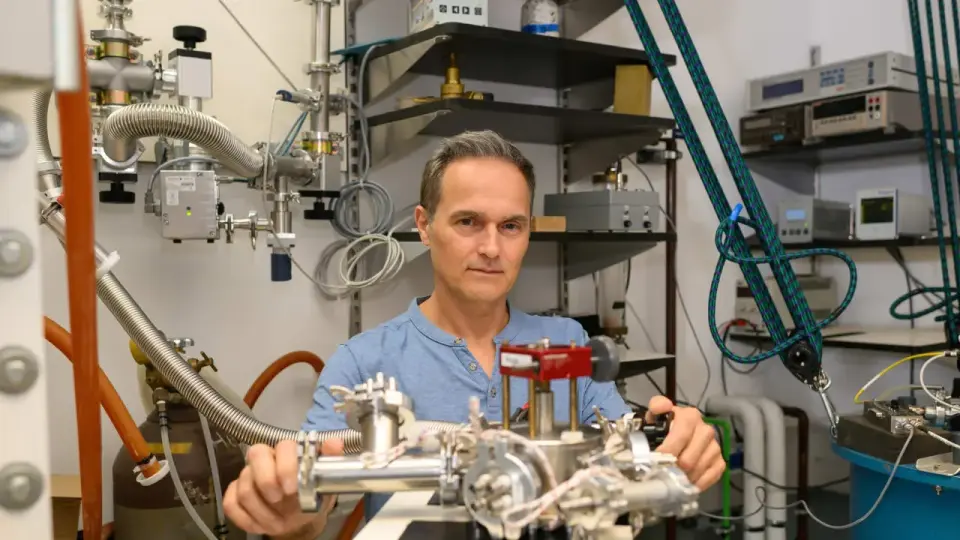
Researchers at the Weizmann Institute of Science have demonstrated a single-molecule rotor inspired by the ancient Archimedes screw. By suspending a helical organic molecule between gold electrodes near absolute zero, they showed that electric current can drive continuous rotation, which in turn increases electrical conductivity by up to 100 times. Published in Nature, this discovery reveals a new feedback loop between mechanical motion and electrical flow, potentially paving the way for future nanoscale switches and sensors, though practical applications remain distant due to extreme temperature requirements.
Key points
- The team created a molecular version of the Archimedes screw using a helical organic molecule called a helicene.
- Electric current exerts torque on the molecule, causing it to spin in a direction determined by the current's polarity.
- As the molecule transitions from stepwise to continuous rotation, its electrical conductivity increases by up to two orders of magnitude.
- The experiment was conducted at 4.2 Kelvin, approximately -269 degrees Celsius, to minimize thermal interference.
- The mechanism differs from previous molecular motors, which relied on excitation and relaxation cycles rather than direct current-driven torque.
Background
This development builds on broader trends in nanotechnology and molecular engineering, where scientists are increasingly exploring single-molecule devices for electronics and energy storage. While previous efforts focused on molecular motors driven by chemical reactions or scanning probe techniques, this study introduces a new principle based on direct electromechanical coupling. It also aligns with recent advancements in synthesizing complex molecular structures, such as the 3D spirocycles developed by Osaka chemists, highlighting the growing capability to manipulate matter at the atomic scale for functional devices.
How outlets are covering it
The Jerusalem Post and UA.News emphasize the dramatic 100-fold increase in conductivity and the historical parallel to the Archimedes screw, framing the discovery as a significant leap in understanding molecular mechanics. Chemistry World provides a more technical perspective, highlighting the specific use of helicene molecules and the collaboration with the University of Copenhagen to synthesize longer helical structures. While all sources agree on the novelty of the current-driven rotation, Chemistry World notes the lack of immediate practical applications, whereas The Jerusalem Post focuses on the potential for future scaling into arrays of molecular rotors for macroscopic effects.
Why it matters
This research establishes a new operating principle for nanomachines, where mechanical motion directly enhances electrical performance. If the team can replicate this effect at room temperature and scale it to arrays of molecules, it could lead to the development of ultra-sensitive sensors, nanoscale pumps, and novel energy storage components. The ability to control molecular rotation through electrical current offers a pathway to integrating mechanical and electronic functions at the smallest possible scale, potentially revolutionizing fields from electronics to fluid transport at the nanoscale.
What to watch
The research team plans to test the effect at room temperature to overcome the current limitation of requiring near-absolute-zero conditions. They also intend to explore a wider variety of chiral molecules to understand how molecular shape affects rotation speed and conductance. Future experiments may involve driving the molecules using circularly polarized light or spin-polarized currents, linking molecular machines to spintronics. Additionally, the team aims to investigate whether large arrays of these molecular rotors can work together to produce useful macroscopic effects, such as transporting fluids or gases along surfaces.
Want the full story? Read the original reporting
Read on The Jerusalem Post