
Engineered Yeast and Gelatin Could Form Low-Energy Concrete for Mars Habitats
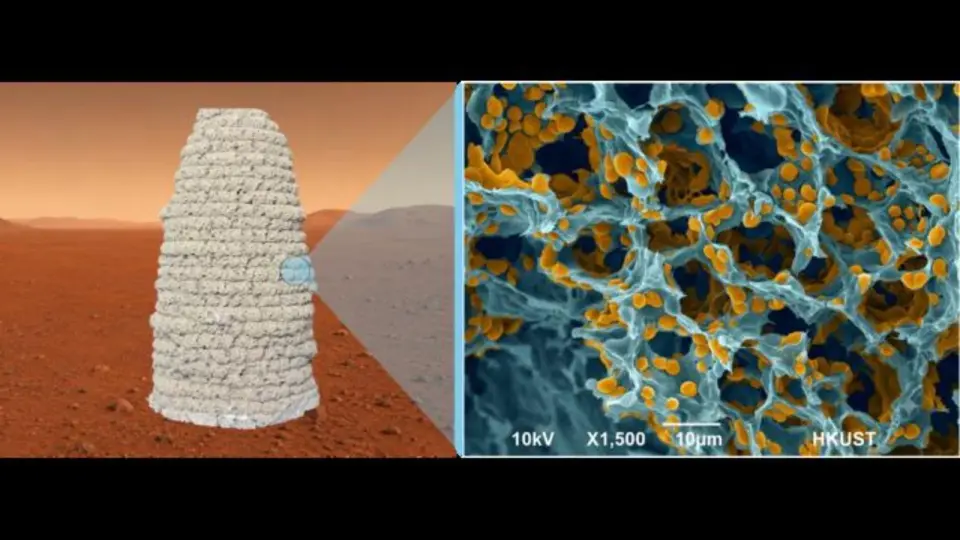
Researchers at the Hong Kong University of Science and Technology have developed a bio-composite material using genetically modified yeast and gelatin to bind Martian regolith. This 'Engineered Living Building Material' offers a low-energy alternative to traditional sintering methods, potentially enabling the construction of durable, recyclable habitats on Mars without shipping heavy materials from Earth.
Key points
- A team led by Ning Liu at HKUST created a concrete-like binder using pork gelatin and genetically engineered Saccharomyces cerevisiae yeast.
- The material uses local Martian sand and regolith as an aggregate, avoiding the need to transport heavy construction materials from Earth.
- The yeast is modified to produce 'mussel foot proteins' for adhesion and 'SpyTag/SpyCatcher' systems for strong covalent bonds between cells.
- The material cures via freeze-drying in the Martian vacuum, utilizing a third genetic modification to prevent ice crystal damage and create a uniform porous structure.
- Prototype tests show a compressive strength of 12 MPa and a flexural strength of 6 MPa, with the latter exceeding traditional concrete, which is crucial for withstanding dust storms.
Background
This development follows earlier research into using biological agents for space infrastructure, such as 2026 studies on using engineered yeast to synthesize food components from recycled plastic for extreme environments. It also aligns with ongoing efforts to find sustainable construction methods for off-world colonies, where traditional energy-intensive sintering of regolith is often deemed impractical due to high power requirements.
How outlets are covering it
Space.com emphasizes the novelty of using biological agents like yeast and gelatin, noting that Liu’s team has already built small-scale prototypes under simulated Martian conditions. The Register highlights the potential for this material to serve as a primary structural component for future astronaut habitats, focusing on the feasibility of 3D printing with the substance. Universe Today provides a more technical critique, detailing the specific genetic modifications (SpyTag/SpyCatcher and anti-freeze proteins) and noting that while the material is recyclable and energy-efficient, it remains porous and requires an internal membrane for pressurization. Universe Today also points out that gelatin currently must be shipped from Earth, a logistical hurdle not emphasized by the other outlets.
Why it matters
This research offers a viable, low-energy pathway for constructing permanent infrastructure on Mars. By utilizing local resources and biological processes instead of high-energy sintering, it reduces the logistical and energy burdens of space colonization. The material’s high flexural strength and recyclability address key challenges in Martian habitat design, such as dust storm resistance and resource conservation, potentially accelerating the timeline for sustainable human presence on the Red Planet.
What to watch
Researchers must address the vulnerability of the material to Martian perchlorates and ultraviolet radiation. Additionally, efforts are needed to develop a method for producing gelatin on Mars or finding a viable substitute, as the current reliance on Earth-shipped gelatin limits the technology's autonomy. Further testing will determine if the yeast can survive long-term exposure to the Martian soil environment.
- Mars settlers may live in houses made of yeast and gelatin Space
- Mars astronauts could live in houses made of yeast and jello, say scientists The Register
- Genetically Engineered Yeast Could Build the First Martian Outposts Universe Today
- Yeast-based Building Material May be Key to 3D Printed Houses on Mars Labcompare
Want the full story? Read the original reporting
Read on Space