
Acoustic data and drone footage reveal new insights on elusive Omura’s whale
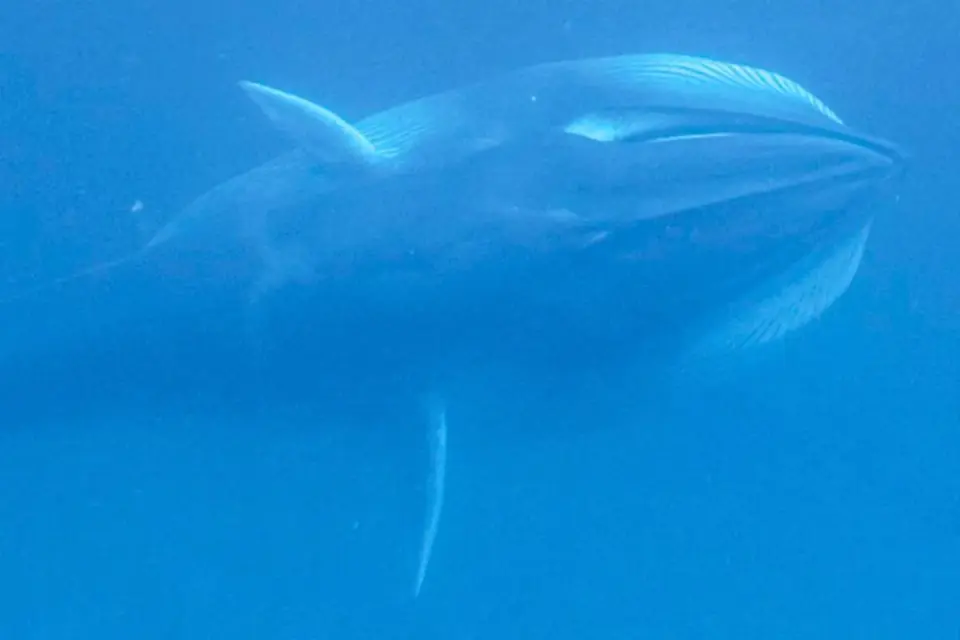
New research combines 18 years of underwater acoustic recordings from Australia with the first-ever drone footage of an Omura’s whale feeding. The acoustic study, published in Marine Mammal Science, shows the whales prefer warm, chlorophyll-rich waters from September to May. Meanwhile, a March 2026 drone capture off Mansaur Island provided the first visual record of the species lunge-feeding, a behavior previously unknown. These findings help clarify the habitat and behavior of a species first recognized in 2003 but still listed as Data Deficient by the IUCN.
Key points
- Curtin University researchers analyzed 18 years of acoustic data (2005–2023) from 35 sites across 1,800km of Australian waters, finding Omura’s whales are most active in warm, high-chlorophyll areas between September and May.
- Dr. Mark Erdmann captured the first-ever footage of an Omura’s whale feeding in March 2026 off Mansaur Island, showing the whale lunge-feeding on plankton, a behavior previously unobserved.
- The species, which grows to about 10 meters and weighs 13 to 30 metric tons, is often mistaken for Bryde’s whales due to similar appearance, though Omura’s have a single head ridge.
- The IUCN lists Omura’s whales as Data Deficient due to limited information, but the new acoustic and visual data provides a baseline for understanding their response to environmental changes and human activities like shipping.
- The Omura’s Whale Project, the only dedicated conservation effort for the species, uses methods including bioacoustics, skin biopsies, and satellite tagging to study populations off Nosy Be, Madagascar.
Background
Omura’s whales were first recognized as a distinct species in 2003, with living specimens formally recorded in 2015. Prior to recent studies, the last major live field study was conducted in 2013 off Madagascar. The species is non-migratory and prefers warm, tropical waters, with global presence confirmed in 2019. Recent Australian defense developments, such as the Ghost Shark UUV, highlight the increasing overlap between military activities and marine conservation in the region, though no direct link to whale research exists.
How outlets are covering it
Discover Wildlife emphasizes the acoustic findings from Curtin University, highlighting seasonal shifts and the importance of chlorophyll levels for conservation planning. Yahoo focuses on the visual milestone of the drone footage, detailing the feeding behavior and the challenges of identifying the species. Both sources agree on the species' rarity and the value of new data, but Discover Wildlife stresses the broader implications for marine planning, while Yahoo highlights the specific contribution of Dr. Erdmann’s footage to understanding feeding habits.
Why it matters
The new data provides a critical baseline for conserving a species with limited information, helping to mitigate impacts from shipping, offshore industry, and climate change. Understanding the whales' preference for warm, productive waters allows for better marine planning and protection of their habitat. The first visual record of feeding behavior also advances scientific knowledge of a species that has been difficult to study due to its elusive nature.
What to watch
Researchers will continue to use the acoustic and visual data to monitor Omura’s whale populations and assess the impact of environmental changes. The Omura’s Whale Project will expand its use of bioacoustics, tagging, and drone footage to gather more data on the species' behavior and distribution. Conservation efforts may also focus on reducing underwater noise from human activities in key habitats.
- Underwater recorders capture sound of mysterious, 10m-long giant off Australian coast BBC Wildlife Magazine
- Researchers Identify Audio from Mysterious 39-Foot Whale Rarely Seen Since Its 2003 Discovery People.com
- Nobody Had Ever Filmed an Omura’s Whale Eating, Then This Drone Did Yahoo
- Eighteen years of whale call research reveals key habitat of mysterious species Phys.org
Want the full story? Read the original reporting
Read on BBC Wildlife Magazine