
New Fossil Pushes Cephalopod Buoyancy System Origin Back 50 Million Years
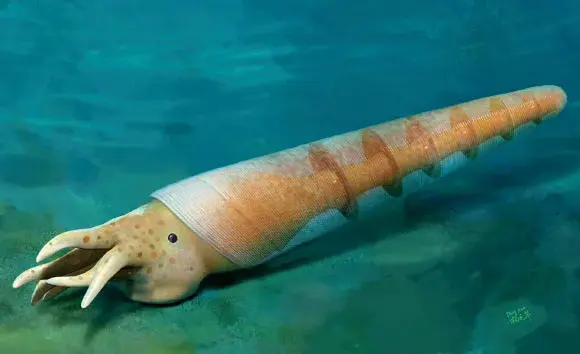
Researchers have identified the earliest known cephalopod with a siphuncle, a tubular structure used for buoyancy control, in a 520-million-year-old fossil from China. This discovery, named Eoceras shaanxiense, fills a significant gap in the evolutionary history of mollusks by pushing the origin of this key innovation back to the Early Cambrian period. The find suggests that the complex internal architecture allowing modern octopuses and nautiluses to regulate buoyancy evolved earlier than previously thought, bridging the gap between molecular clock estimates and the fossil record.
Key points
- A team led by Zuchen Song of Chang’an University identified 32 specimens of a new species, Eoceras shaanxiense, from the Shuijingtuo Formation in China.
- The fossil dates to approximately 520 million years ago, during the Early Cambrian epoch.
- Eoceras shaanxiense is the earliest known cephalopod to possess a siphuncle, a tube that connects shell chambers to regulate buoyancy.
- The specimen had a straight, cone-shaped shell with multiple internal walls and a segmented tube running along its underside.
- The discovery pushes back the fossil record of the siphuncle by roughly 50 million years, closing a gap between molecular estimates and previous fossil evidence.
- The study was published in the journal Nature on July 29, 2026.
Background
This discovery follows a trend of recent paleontological finds that refine the evolutionary timelines of various species. For instance, in July 2026, researchers identified a 2.8-million-year-old honeybee fossil in Japan that bridged a two-million-year gap in the fossil record. Similarly, in June 2026, a reclassified dinosaur fossil from Antarctica provided new insights into the dispersal of titanosaur species. These findings, along with the new cephalopod fossil, highlight how new discoveries continue to reshape our understanding of ancient life and evolutionary timelines.
Why it matters
The discovery of Eoceras shaanxiense is significant because it resolves a major gap in the evolutionary history of cephalopods. By confirming the presence of a siphuncle in the Early Cambrian, it aligns the fossil record with molecular clock estimates that suggest the lineage diverged from other mollusks during this period. This finding provides crucial insights into the early stages of buoyancy regulation in cephalopods, a key innovation that enabled them to adopt a predatory lifestyle. It also underscores the importance of the Shuijingtuo Formation in China as a source of critical paleontological evidence.
What to watch
Researchers will likely continue to study the Shuijingtuo Formation for additional fossils that may further refine the evolutionary timeline of cephalopods. The discovery of Eoceras shaanxiense may also prompt further investigations into the soft-tissue anatomy of early cephalopods, which remains unknown. Additionally, the finding may lead to new hypotheses about the ecological roles of early cephalopods and their interactions with other marine organisms during the Cambrian period.
Want the full story? Read the original reporting
Read on Sci.News