
Apophis 2029: A Global Naked-Eye Spectacle and Scientific Testbed
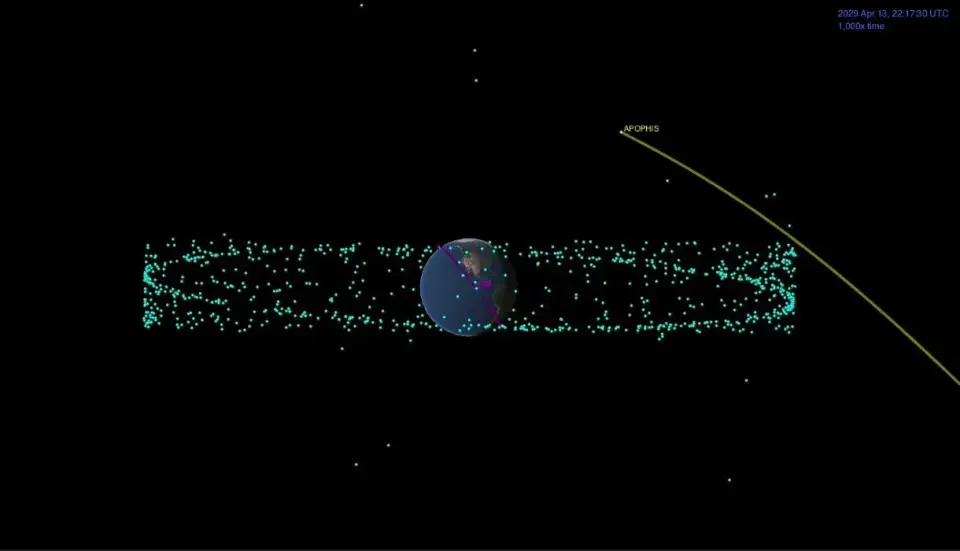
On April 13, 2029, asteroid 99942 Apophis will pass within 32,000 km of Earth, closer than geostationary satellites. NASA confirms no impact risk for a century. Up to 90% of the global population may see it naked-eye, while three international spacecraft missions will study its gravitational response to Earth.
Key points
- Apophis, a 340-meter stony asteroid, will pass Earth at 32,000 km altitude on April 13, 2029, inside the geostationary satellite belt but far from low-Earth orbit satellites.
- NASA has ruled out any impact risk for at least 100 years, following precise radar measurements in 2021 that eliminated previous uncertainty from 2004 observations.
- Visibility maps from June 2026 suggest up to 7.6 billion people (90% of the population) could potentially see the asteroid with the naked eye during its seven-hour passage, though actual visibility depends on weather and light pollution.
- Three major space missions will observe the event: ESA’s Ramses, JAXA’s DESTINY+, and NASA’s OSIRIS-APEX, which will study changes in Apophis’s orbit and surface caused by Earth’s gravity.
- The flyby serves as a natural experiment for planetary defense, helping scientists understand how rubble-pile asteroids respond to gravitational stress, which informs future deflection strategies.
Background
Apophis was discovered in 2004, initially raising alarm with a 2.7% impact probability for 2029. Precovery images and later radar observations eliminated this risk. Our earlier coverage in July 2026 highlighted the unprecedented nature of this close approach and the coordination of global observations, noting that while the asteroid is safe, its trajectory will shift slightly due to Earth’s gravity, reclassifying it from an Aten to an Apollo asteroid.
How outlets are covering it
Space Daily emphasizes the public spectacle and the historical context of Apophis’s impact probability, noting that the 90% visibility figure is a cumulative potential, not a simultaneous audience. Yahoo highlights the international coordination of missions, including a potential Chinese CubeSat, and the technical challenges of observing Apophis’s brighter surface compared to previous targets. HuffPost UK focuses on the practical viewing aspects, noting the asteroid’s size relative to the Empire State Building and the visibility in the Eastern Hemisphere. Zamin.uz reiterates the safety and visibility statistics, aligning with the broader consensus that the event is a safe, rare opportunity for observation and study. All sources agree on the safety of the flyby but differ in emphasis: Space Daily on the scientific value, Yahoo on the mission logistics, and HuffPost on the public experience.
Why it matters
The 2029 Apophis flyby is a rare, safe opportunity to observe a large asteroid at close range, providing critical data on asteroid structure and gravitational interactions. This knowledge enhances planetary defense capabilities by revealing how rubble-pile asteroids respond to stress, informing future deflection missions. The event also serves as a global educational moment, demonstrating the effectiveness of early detection and orbital tracking in mitigating asteroid threats.
What to watch
ESA’s Ramses and JAXA’s DESTINY+ are scheduled to launch in 2028, with Ramses arriving before the flyby to monitor Apophis during and after the encounter. NASA’s OSIRIS-APEX will arrive in June 2029 to study the asteroid post-encounter. Ground-based observatories and radar systems will coordinate observations to refine Apophis’s orbit and surface characteristics. Updated orbital data before 2029 will further refine visibility predictions and scientific models.
- Asteroid Apophis, named for the Egyptian god of chaos, will pass closer to Earth on 13 April 2029 than many weather satellites do — roughly 32,000 kilometres from the surface — and up to 90% of the world's population may see it with the naked eye Space Daily
- Spacecraft will swarm asteroid Apophis during fateful 2029 Earth flyby Yahoo
- An Asteroid The Size Of The Empire State Building Is Set To Pass Close To Earth HuffPost UK
- Billions of People Will See Apophis Asteroid with the Naked Eye in 2029 zamin.uz
- Empire State building-sized asteroid to pass close to Earth: What scientists know The News International
Want the full story? Read the original reporting
Read on Space Daily