
S301: The Milky Way’s Fastest Star Offers a New Window into Black Hole Spin
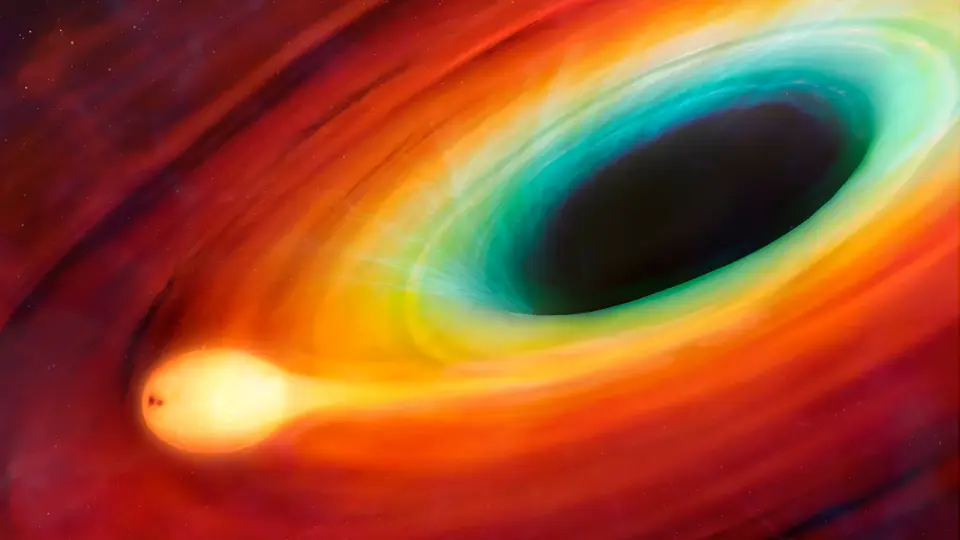
Astronomers have identified S301, a faint star orbiting the Milky Way’s central black hole, Sagittarius A*, at record-breaking speeds. With an 8.7-year orbital period and a peak velocity of 25,000 km/s (8% the speed of light), S301 passes closer to the black hole than any previously observed star. This extreme proximity allows scientists to test Einstein’s general relativity and potentially measure the black hole’s spin within the next decade, a feat previously thought to require decades of observation.
Key points
- S301 completes an orbit around Sagittarius A* every 8.7 years, making it the fastest known star in the galaxy.
- The star reaches speeds of 25,000 km/s at its closest approach, moving at 8% the speed of light.
- Its pericenter distance is approximately 136–142 Schwarzschild radii, roughly 10 times closer than the previously benchmark star S2.
- The discovery was reported in Nature on August 19, 2026, based on observations from the GRAVITY instrument at the ESO’s Very Large Telescope.
- Researchers expect to measure the spin of Sagittarius A* within 10 years using S301’s orbital data.
Background
This discovery builds on decades of observation of stars orbiting Sagittarius A*, particularly the star S2, which has been tracked since 1992. S2’s 16-year orbit confirmed key predictions of general relativity, including gravitational redshift and Schwarzschild precession. However, measuring the black hole’s spin requires a star that passes much closer to the event horizon, as the spin’s effect on spacetime diminishes rapidly with distance. Recent archive coverage from August 2026 highlighted S301’s discovery as a breakthrough in testing the limits of general relativity and understanding black hole dynamics.
How outlets are covering it
Live Science emphasizes S301’s role as a 'luminous probe' of curved spacetime, highlighting its potential to test alternative theories of gravity. WIRED focuses on the star’s anomalous speed and the possibility that it was once part of a binary system torn apart by tidal forces. The Nature article provides the technical details, noting that S301’s orbit is sensitive to the Kerr metric’s spin-induced corrections, which are of order β³, compared to the β² effects seen in S2. All sources agree that S301’s extreme proximity to Sagittarius A* makes it a unique tool for measuring the black hole’s spin, a property that has been difficult to determine directly.
Why it matters
Measuring the spin of Sagittarius A* is critical for understanding how black holes form and evolve. The spin affects the structure of spacetime around the black hole and influences the behavior of matter and light in its vicinity. S301’s orbit provides a direct, dynamical way to measure this property, potentially confirming or challenging Einstein’s general relativity. Additionally, the discovery of S301’s origin as a captured component of a binary system offers insights into the dynamics of stars near supermassive black holes.
What to watch
Astronomers will continue to track S301’s orbit, with the next pericenter passage expected in 2031. Within the next decade, researchers aim to measure the spin of Sagittarius A* using data from S301’s orbit. Future observations with extremely large telescopes and spectroscopy will help refine these measurements and test the predictions of general relativity with greater precision.
- Astronomers spot the closest, fastest star ever seen orbiting our galaxy's monster black hole Live Science
- Scientists just found the fastest known star in the Milky Way. It zooms around our black hole at 15,500 miles per second Space
- Acabamos de descubrir la estrella más veloz de la galaxia y la usaremos para explorar un agujero negro supermasivo WIRED
- Discovery of a star sensitive to the spin of Sagittarius A* Nature
- A star that feels our Galaxies central black hole rotate Max-Planck-Gesellschaft
Want the full story? Read the original reporting
Read on Live Science