
New Imaging Confirms IC 1101 as the Universe’s Largest Galaxy
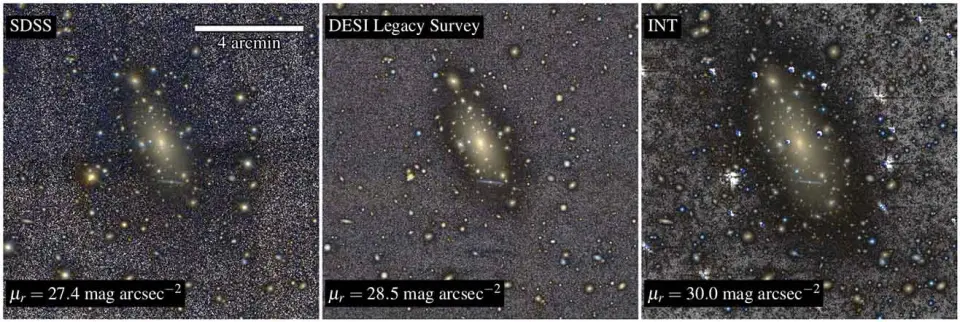
Astronomers have confirmed IC 1101 as the largest known galaxy, measuring approximately 1.7 million light-years across and containing 3.4 trillion solar masses of stars. Led by Carlos Marrero-de la Rosa, the team used ultra-deep images from the Isaac Newton Telescope to map the galaxy’s faint outer edges, which had previously been obscured by foreground light. The study reveals that IC 1101 is 17 times wider than the Milky Way and continues to grow through recent mergers, solidifying its status as a dominant brightest cluster galaxy.
Key points
- IC 1101 spans roughly 1.7 million light-years, making it 17 times wider than the Milky Way.
- The galaxy contains an estimated 3.4 trillion solar masses of stars, far exceeding the Milky Way’s total mass.
- Researchers used the Wide Field Camera at the Isaac Newton Telescope to capture the deepest images of the galaxy to date.
- The team developed a model to subtract scattered light from over 250 foreground stars, improving image contrast.
- Evidence suggests IC 1101 is still growing, with eight structures identified beyond its main edge indicating ongoing accretion.
Background
Recent cosmic surveys, such as the JWST’s COSMOS-Web program and DESI data, have mapped large-scale structures and hinted at non-uniformities in the universe. While these studies focus on the distribution of galaxies across billions of light-years, the current finding highlights the extreme scale of individual massive galaxies within those structures. IC 1101’s formation through the merger of smaller galaxies aligns with broader theories of how massive dark matter halos and environmental quenching shape galaxy evolution in dense clusters.
Why it matters
This study refines our understanding of the upper limits of galaxy size and mass, providing a concrete benchmark for cosmological models. By accurately measuring the faint outer boundaries of IC 1101, scientists can better understand the processes of galactic accretion and the role of dark matter in shaping the largest structures in the universe. The techniques developed to overcome foreground light pollution also offer new methods for observing other faint, distant objects.
What to watch
The research team plans to publish their findings in a future issue of Astronomy and Astrophysics. Further analysis of the eight structures beyond IC 1101’s main edge may reveal more about the timeline and nature of its recent mergers. Additionally, the star subtraction algorithms developed for this study could be applied to other brightest cluster galaxies to map their extents more accurately.
- New Observations Reveal the Staggering Scale of the Universe’s Largest Galaxy The Debrief
- Astronomers finally measure the full size of the largest known galaxy Phys.org
- The Largest Galaxy In The Universe Is Even Bigger Than We Thought… And It Hasn't Finished Growing iflscience.com
- Best of 2026-08-01 Phys.org
Want the full story? Read the original reporting
Read on The Debrief