
Unified Supernova Data Suggests Dark Energy Is Fading, Not Constant
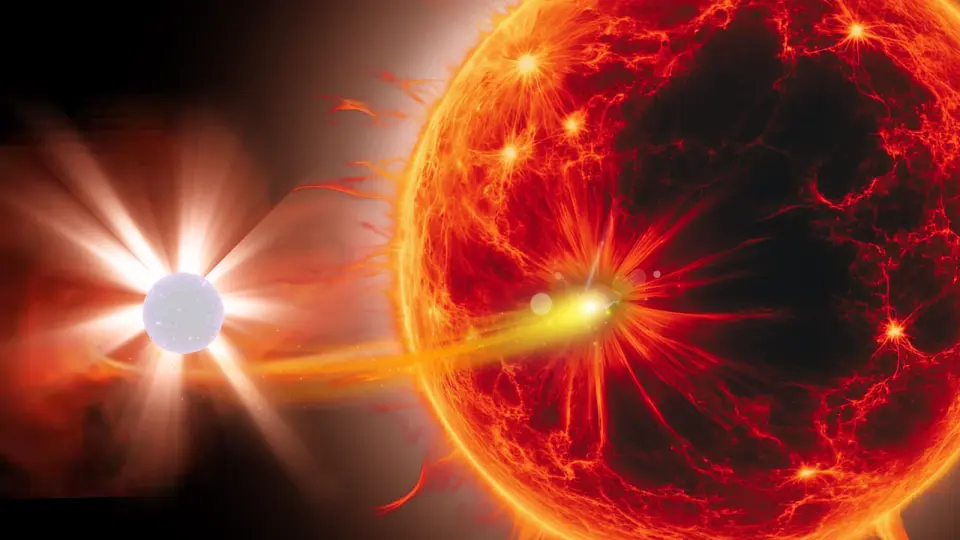
A new analysis of 2,884 Type Ia supernovae indicates that dark energy may be weakening over time rather than remaining constant. This finding, which reaches a 3.1-sigma statistical significance, aligns with recent data from the Dark Energy Spectroscopic Instrument (DESI) and challenges the standard cosmological model. While the evidence is strong, it has not yet reached the five-sigma threshold required for a definitive discovery, leaving room for debate among cosmologists.
Key points
- Researchers at the University of Queensland created the 'Unite' dataset, merging 2,884 supernovae from the Pantheon+ and Dark Energy Survey (DES) into a single, consistent analysis framework.
- The study finds a 3.1-sigma preference for evolving dark energy, suggesting its influence is decreasing as the universe ages, contrary to the fixed cosmological constant model.
- The results are consistent with earlier findings from DESI (2024) and DES (2024), which also hinted at time-varying dark energy, though the new data provides a tighter constraint.
- The analysis accounts for gravitational lensing and host-galaxy mass, reducing systematic errors that plagued previous combined datasets.
- Upcoming data from the Vera Rubin Observatory and the Roman Space Telescope will provide larger samples to test these findings further.
Background
This development follows a series of recent studies in 2026 questioning the standard model of cosmology. In August 2026, researchers re-analyzed claims that cosmic acceleration was an illusion, confirming that expansion is still accelerating but debating the nature of the driving force. Earlier in the year, DESI results highlighted a 'Hubble tension' between early-universe and local measurements, suggesting dark energy might not be constant. The current study builds on these tensions by unifying disparate supernova catalogs to reduce calibration errors.
How outlets are covering it
Space.com and Sci.News emphasize the 'Unite' dataset as a major step forward, highlighting the 3.1-sigma evidence for evolving dark energy and the improved consistency of the data. Tech Times provides a detailed technical breakdown, noting that while the frequentist analysis shows a strong preference for evolving dark energy, Bayesian model comparison offers only a 'weak preference' due to the added complexity of the model. Science Daily presents a contrasting view from a separate Oxford-led study, which argues that after correcting for stellar ages, the universe may actually be decelerating, not accelerating, and that any apparent acceleration is directional rather than uniform. This highlights a significant divide: while most evidence points to evolving dark energy, some researchers argue the acceleration itself may be an artifact of uncorrected systematic errors.
Why it matters
If dark energy is not constant, it implies the universe's expansion history is more complex than previously thought, potentially altering predictions about its ultimate fate. A non-constant dark energy could resolve the 'worst prediction in physics' regarding the cosmological constant's value and may provide a bridge between quantum mechanics and general relativity. However, the current evidence is not yet definitive, and the scientific community awaits larger datasets from upcoming observatories to confirm or refute these findings.
What to watch
The Vera Rubin Observatory's Legacy Survey of Space and Time (LSST) and the Roman Space Telescope are expected to provide hundreds of thousands of supernova measurements in the coming years. These larger datasets will help determine whether the 3.1-sigma signal for evolving dark energy strengthens to a definitive discovery or if it is a statistical fluke. DESI's Data Release 3 is also anticipated within the next year, which will further tighten constraints on dark energy's evolution.
- Scientists study 3,000 supernovas and discover that dark energy may be evolving Space
- Dark Energy May Not Be Constant After All, New Supernova Survey Suggests Sci.News
- Dark energy debunked? Cosmic acceleration may be an illusion Science Daily
- Unified Supernova Catalog Delivers Sharpest Dark Energy Constraints on Record Tech Times
- Most extensive catalog of supernovae challenges dark energy theory Universe Space Tech
Want the full story? Read the original reporting
Read on Space