Tag

Desi

All articles tagged with #desi

Five-Year Sky Survey Maps 47 Million Galaxies to Probe Dark Energy
space15 days ago

Five-Year Sky Survey Maps 47 Million Galaxies to Probe Dark Energy

The Dark Energy Spectroscopic Instrument (DESI) completed the most detailed cosmic survey to date, mapping more than 47 million galaxies and quasars across about 14,000 square degrees to create a 3D map of the universe. The dataset aims to test whether dark energy evolves over time and will be analyzed further before broader public access, with future observations planned to extend the coverage and duration into the 2030s.

April’s science images spotlight a detailed 3D map of the universe and other breakthroughs
science19 days ago

April’s science images spotlight a detailed 3D map of the universe and other breakthroughs

April’s best science images span cosmic to terrestrial: the DESI project delivers the most detailed 3D map of the universe from 47 million galaxies and quasars, accompanied by Earth-bound highlights such as climate-threatened cherry blossoms in Japan, the discovery of a new endangered Liopholis mutawintji skink in Australia, a lab-grown dinosaur-collagen leather bag, insights into limb regeneration, advanced 3D imaging of coral skeletons with deep learning, and NASA’s Artemis II Moon fly-by with Space Launch System boosters.

Largest 3D Map of the Universe Deepens Cosmology Puzzle
space1 month ago

Largest 3D Map of the Universe Deepens Cosmology Puzzle

DESI finished its first official survey, delivering the largest high‑resolution 3D map of the cosmos—47 million galaxies and 20 million stars across 11 billion years—unlocking a data trove that could test the constant nature of dark energy (lambda) and reveal potential evolution. While previous hints suggested possible tensions with the standard model, scientists emphasize careful error analysis and independent confirmation. With six data‑heavy paper batches planned and follow‑on surveys like Euclid and Rubin Observatory on the horizon, the DESI results are likely to refine or challenge current cosmology rather than settle it outright.

Desi's 47 Million Galaxy Map Reveals the Cosmic Web and Dark Energy’s History
science1 month ago

Desi's 47 Million Galaxy Map Reveals the Cosmic Web and Dark Energy’s History

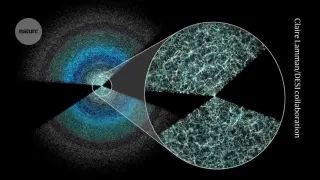
The Dark Energy Spectroscopic Instrument (DESI) at Kitt Peak National Observatory has produced the largest 3D map of the universe, charting about 47 million galaxies and more than 20 million Milky Way stars over a five-year survey. The map uncovers the cosmic web of filaments and voids and enables researchers to track how dark energy has shaped the universe’s expansion over the last 11 billion years, with DESI continuing observations through 2028 to expand the dataset and first full results anticipated in 2027.

DESI's 3D Universe Map Charts 47 Million Galaxies to Probe Dark Energy
space1 month ago

DESI's 3D Universe Map Charts 47 Million Galaxies to Probe Dark Energy

The Dark Energy Spectroscopic Instrument (DESI) has produced the largest high‑resolution 3D map of the universe, cataloging about 47 million galaxies (and more than 20 million nearby stars) into a cosmic web of filaments and voids. By mapping galaxy positions over roughly 11 billion years, scientists aim to understand how dark energy shapes cosmic expansion; DESI will continue observations through 2028 to expand the map by ~20%, with first full dataset results expected in 2027.

Cosmic Census Reaches New Depths: DESI Unveils the Largest 3D Map, Hinting Dark Energy Might Evolve
science1 month ago

Cosmic Census Reaches New Depths: DESI Unveils the Largest 3D Map, Hinting Dark Energy Might Evolve

The Dark Energy Spectroscopic Instrument (DESI) has produced the universe’s largest 3D map, cataloging 47 million galaxies and quasars—well above its target—across five years. Published in Astronomy & Astrophysics, the data could prompt a major shift in cosmology, with early results suggesting dark energy may not be constant and could be weakening the universe’s acceleration, challenging the standard LCDM model.

Cosmic CT Scan Maps 47 Million Galaxies in Unprecedented 3D Atlas
science1 month ago

Cosmic CT Scan Maps 47 Million Galaxies in Unprecedented 3D Atlas

Scientists using the Dark Energy Spectroscopic Instrument (DESI) have unveiled the most detailed 3D map of the universe, cataloging more than 47 million galaxies (and 20 million stars) with a 5,000-fiber system at Kitt Peak. The map reveals the cosmos’s structure and traces light back over 11 billion years, helping to study dark energy; first dark-energy results from the five-year data are expected in 2027, with plans to expand the survey to roughly 17,000 square degrees in coming years. The effort involved 900 scientists from 70 institutions.

Cosmic atlas reveals 47 million galaxies to probe dark energy
science1 month ago

Cosmic atlas reveals 47 million galaxies to probe dark energy

Astronomers using the Dark Energy Spectroscopic Instrument (DESI) have completed the largest high‑resolution 3D map of the universe, mapping more than 47 million galaxies. The dataset could sharpen our understanding of dark energy and the cosmic expansion, potentially testing whether dark energy is the cosmological constant, with about 20% more sky to be added by 2028 and definitive dark‑energy results expected in 2027.

DESI Wraps Its First Major 3D Map and Expands the Cosmic Survey
science1 month ago

DESI Wraps Its First Major 3D Map and Expands the Cosmic Survey

DESI finished its originally planned five-year survey ahead of schedule, delivering the largest high-resolution 3D map of the universe by observing more than 47 million galaxies and quasars and 20 million nearby stars. The endeavor will extend the map to about 17,000 square degrees by 2028 to improve studies of dark energy and dark matter, with first full five-year results expected in 2027. The effort overcame challenges from COVID-19, the 2022 Kitt Peak fire, and weather, and will continue processing the data and expanding observations to new galaxy populations as DESI pushes deeper into cosmic history.

DESI's 3D universe map hints dark energy is weakening, sparking a cosmology rethink
space1 month ago

DESI's 3D universe map hints dark energy is weakening, sparking a cosmology rethink

DESI finished its five-year survey, delivering the largest-ever 3D map of the cosmos (about 47 million galaxies/quasars and 20 million stars). Early analyses suggest dark energy may be weakening, a finding that could challenge the Lambda-CDM cosmology and signal a major shift in our understanding of the universe; further data from the full map are expected.

Tiny Measurement Bias Could Resolve the Dark Energy Tension
science3 months ago

Tiny Measurement Bias Could Resolve the Dark Energy Tension

A new paper by Slava Turyshev argues that small systematic biases in how we measure supernova brightness and the standard ruler set by baryon acoustic oscillations could explain the DESI DR2–CMB mismatch, potentially removing the case for evolving dark energy. He also advocates the Alcock-Paczynski diagnostic to reduce dependence on early-universe benchmarks and outlines scenarios like the Late-Transition Interacting Thawer (LTIT) and Phantom Crossing as alternative explanations, with upcoming data from Euclid expected to test these ideas.

Viscous Universe: A Fluid-Damped Expansion Could Redefine Dark Energy
science3 months ago

Viscous Universe: A Fluid-Damped Expansion Could Redefine Dark Energy

A new preprint suggests empty space behaves like a viscous fluid with bulk viscosity that resists expansion, introducing a time-varying drag on cosmic expansion to address DESI measurements. If future data from galaxy surveys, supernovae, and lensing align with this drag pattern, the idea could challenge the idea of a constant dark-energy driver, potentially replacing it with a dynamic picture—but the proposal remains speculative and requires peer review and broader observational checks.

Dark-energy clues push the universe toward a future Big Crunch
cosmology3 months ago

Dark-energy clues push the universe toward a future Big Crunch

New measurements from the Dark Energy Survey (DES) and DESI suggest the cosmological constant may be negative, causing the universe to keep expanding for about 11 billion more years before contracting to a Big Crunch roughly 20 billion years from now, for an approximate total lifespan of 33 billion years. The scenario relies on evolving dark energy, potentially linked to a very light particle, and is consistent with observations from DES and DESI, with future surveys like Euclid, SPHEREx, and Rubin Observatory planned to test the idea.