A new catalog of 2,884 Type Ia supernovae suggests dark energy may change over time, challenging the standard model of a constant cosmic expansion. While the evidence is not yet conclusive, it aligns with recent hints from other cosmic surveys.
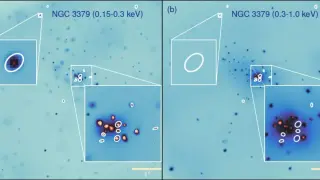
Astronomers have identified 84 previously undetected objects in six nearby galaxies, dubbed 'hypersoft X-ray sources,' which emit low-energy X-rays but likely produce vast amounts of extreme ultraviolet radiation. Hidden by interstellar gas, these objects may include white dwarfs accreting matter, potentially solving the mystery of missing Type Ia supernova progenitors and illuminating how galaxies evolve.
A reanalysis of Pantheon+ Type Ia supernovae, including a correction for the ages of progenitor stars, finds the cosmic expansion may be slowing instead of accelerating and that the apparent acceleration varies with direction. This challenges the dark energy paradigm, though other studies still support acceleration. The Rubin Observatory’s LSST is expected to provide a decisive test with a much larger supernova sample.
New analysis of Type Ia supernovae data, with progenitor-age corrections from the Pantheon+ catalog, suggests the universe’s expansion may be mildly anisotropic and not accelerating uniformly in all directions. If younger supernova progenitors are fainter after standardization, distant observations could mimic acceleration, meaning the apparent cosmic acceleration could be a local, directional effect tied to our motion through the cosmos. This challenges the isotropy assumed in ΛCDM and raises doubts about dark energy's role, while also intersecting with the ongoing Hubble tension between local and early-universe expansion rates.
Quanta Magazine’s The Joy of Why interview with Adam Riess traces how Type Ia supernovae revealed the universe’s accelerating expansion, explains the local vs. early-universe measurements of the Hubble constant, and frames the current Hubble tension that challenges the Lambda-CDM model. Riess discusses how standard candles and redshift work together to map expansion, the role of dark energy (potentially a cosmological constant), and how upcoming observatories like the Nancy Grace Roman Space Telescope, Rubin Observatory, Euclid, and JWST aim to resolve whether the tension signals new physics or hidden systematics.
A new MNRAS analysis reinforces that the universe’s expansion is still accelerating, countering a recent paper that argued measurement biases could mimic deceleration; after recalibrating for stellar ages, host-galaxy mass, and environmental factors, the results remain consistent with ongoing cosmic acceleration, underscoring the Big Freeze fate while highlighting ongoing scientific scrutiny of dark energy.
Physicists propose that the universe may be filled with particles called tachyons, capable of traveling faster than light, which could potentially make up dark matter and explain the universe's ongoing expansion. This hypothesis challenges the current cosmological model and raises fundamental questions about causality. While the evidence is limited and the existence of tachyons remains unproven, the idea offers intriguing possibilities for further research into the nature of dark matter and the fundamental phenomena governing the cosmos.
The Dark Energy Survey (DES) has released its final measurement at the 243rd American Astronomical Society meeting, providing one of the most precise measurements yet of the elusive parameter "w" for dark energy. This measurement, which gives a value of -0.8, challenges the predicted value of -1, potentially indicating that dark energy may not be the cosmological constant proposed by Einstein. However, the uncertainty in the measurement leaves room for the possibility of it still being the cosmological constant. The results may signal the end of "Big Rip" models, and future telescopes like ESA's Euclid mission and the Vera Rubin Observatory are expected to provide more data for further understanding of dark energy.
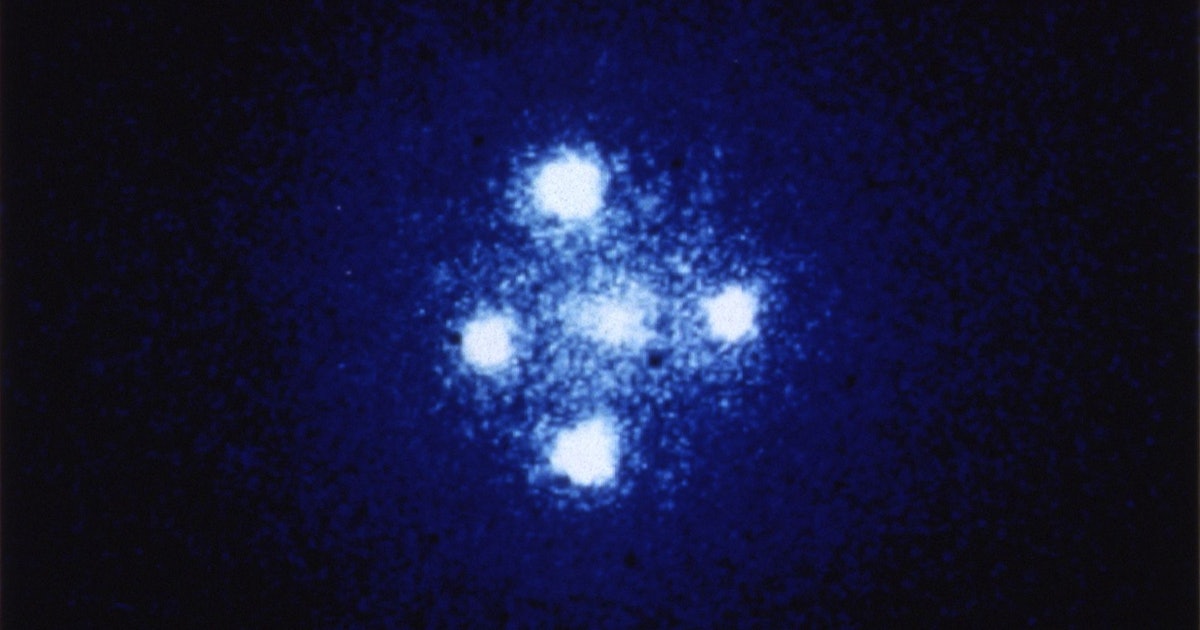
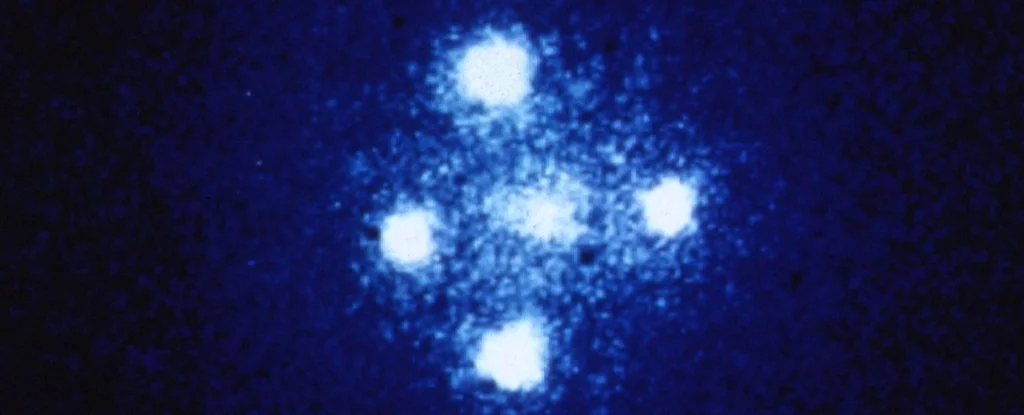
An international team of astronomers led by Ariel Goobar of the Oskar Klein Centre at Stockholm University discovered an unusual Type Ia supernova, SN Zwicky (SN 2022qmx), and observed it four times thanks to a gravitational lens. The team observed an “Einstein Cross,” a phenomenon predicted by Einstein’s Theory of General Relativity where the presence of a gravitational lens in the foreground amplifies light from a distant object. The discovery of SN Zwicky presents numerous opportunities for astronomers, including the ability to study it in greater detail and further investigate the mysteries of gravitational lenses.
An international team of researchers led by Ariel Goobar of the Oskar Klein Centre at Stockholm University discovered an unusual type Ia supernova, SN Zwicky (SN 2022qmx), and observed an "Einstein ring", an unusual phenomenon predicted by Einstein's theory of general relativity where the presence of a gravitational lens in the foreground amplifies light from a distant object. The team observed two very rare astronomical events that happened to coincide, and the discovery presents numerous opportunities for astronomers, including the ability to study SN Zwicky in greater detail and further investigate the mysteries of gravitational lenses.
Astronomers have observed an unusual Type Ia supernova, SN Zwicky, four times thanks to a gravitational lens, an unusual phenomenon predicted by Einstein's Theory of General Relativity. The team observed it with the Zwicky Transient Facility, the adaptive optics at the W.M. Keck Observatory, and the Very Large Telescope. The Hubble Space Telescope confirmed that the multiple-image lensing effect resulted from a galaxy in the foreground that magnified the supernova 25 times. This discovery presents numerous opportunities for astronomers, including the ability to study SN Zwicky in greater detail and further investigate the mysteries of gravitational lenses.
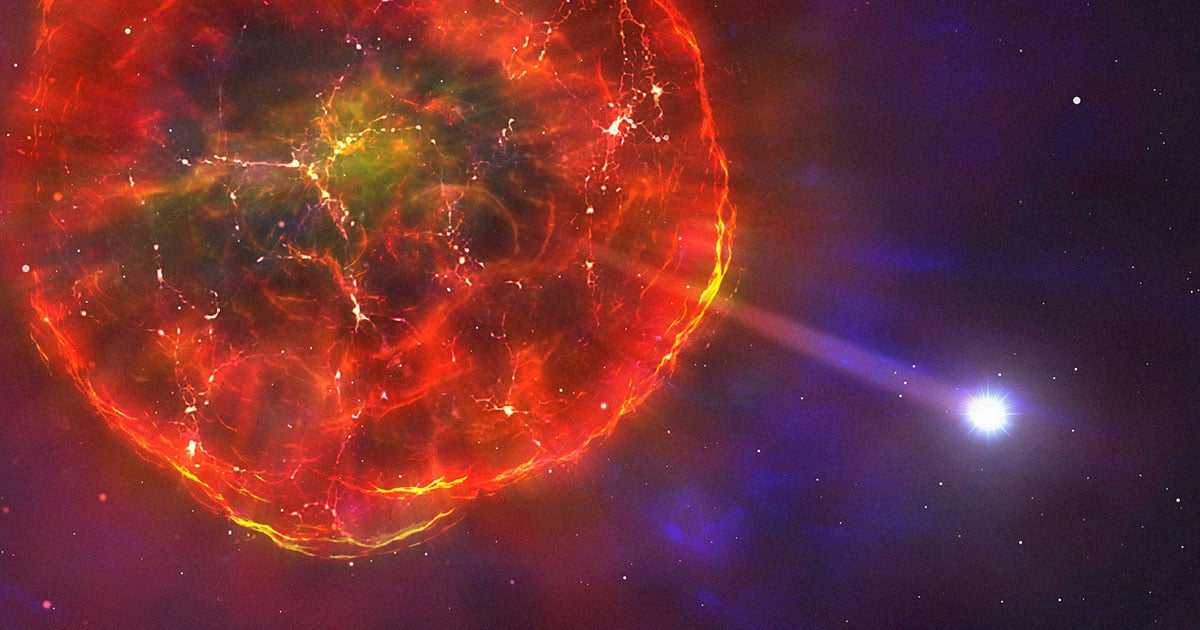
Researchers have identified six new runaway stars in the Milky Way, including the fastest known star to have ever escaped the galaxy, which was propelled by a massive thermonuclear blast. Four of the stars were likely pushed out as a result of Type Ia supernovae, which occur in binary star systems where one star is a white dwarf. These hypervelocity stars could help researchers calculate the birth rates of stars and discover more runaway stars.
Scientists have discovered six more runaway stars in the Milky Way, including the fastest object of this type yet detected in the galaxy. Four of the newly measured objects are hypervelocity stars, traveling at speeds that exceed the escape velocity of the Milky Way, and all four are likely the result of spectacular Type Ia supernovae. The discovery has allowed for a new calculation of the rate at which these stars are born, and found that it is consistent with the estimated rate of Type Ia supernovae.