
Endothelial cells adapt to VEGFR2 loss by becoming venous, revealing a new angiogenesis mechanism
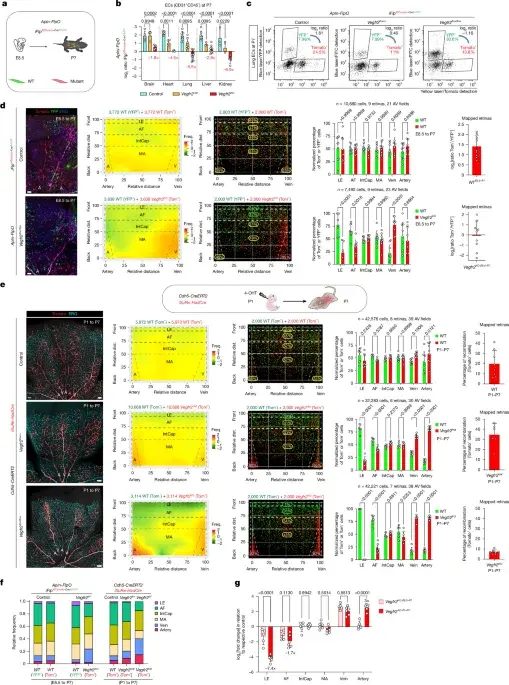
Researchers found that endothelial cells lacking the VEGFR2 receptor can survive and proliferate by adopting a venous identity, a process called venousization. While VEGFR2 is essential for initial blood vessel sprouting, its absence does not prevent long-term vascular growth in veins, which serve as a continuous source for new vessels. This adaptation mechanism may explain resistance to anti-VEGF cancer therapies.
Key points
- Endothelial cells without VEGFR2 cannot sprout during the first wave of angiogenesis but survive and proliferate in veins.
- Venousization involves upregulating venous-specific genes, particularly NR2F2, allowing mutant cells to outcompete wild-type cells in venous networks.
- Single-cell RNA sequencing showed that long-term loss of VEGFR2 leads to significant transcriptional changes, including increased expression of ligands for VEGFR1 and VEGFR3.
- Loss of NR2F2, a master regulator of venous development, significantly compromises the expansion of VEGFR2-deficient endothelial cells, confirming venousization as a key adaptation strategy.
- These findings suggest that resistance to anti-VEGF therapies in cancer may arise from endothelial cells adapting through venousization rather than relying on VEGF signaling.
Background
Previous studies established VEGFR2 as essential for endothelial differentiation and survival, with complete loss leading to embryonic lethality. Anti-VEGF therapies are widely used in cancer but often face resistance. This study uses genetic mosaics to track VEGFR2-deficient cells over time, revealing a previously unknown adaptive mechanism in vascular development.
How outlets are covering it
The primary source from Nature provides detailed experimental evidence using iFlpMosaics and single-cell RNA sequencing to demonstrate venousization as a mechanism of adaptation. The secondary source from Demócrata is a 403 error page and provides no relevant information. No conflicting perspectives are available from the provided sources.
Why it matters
Understanding how endothelial cells adapt to VEGFR2 loss could improve the design of anti-VEGF therapies by targeting venousization pathways. It also clarifies the role of VEGF receptors in different vascular contexts, showing that veins are less dependent on VEGFR2 than capillaries or arteries.
What to watch
Researchers may investigate how venousization can be inhibited to enhance the efficacy of anti-VEGF treatments. Further studies could explore the role of NR2F2 and other venous markers in cancer progression and metastasis.
- Venousization enables angiogenesis in the absence of VEGFR signalling Nature
- Alternative pathways for blood vessel growth could become targets against drug-resistant tumors Medical Xpress
- Photo (IMAGE) EurekAlert!
- They reveal how blood vessels manage to grow without one of their key signals Demócrata
- Image EurekAlert!
Want the full story? Read the original reporting
Read on Nature