
Food odors gate fruit fly courtship via multisensory feedback loops
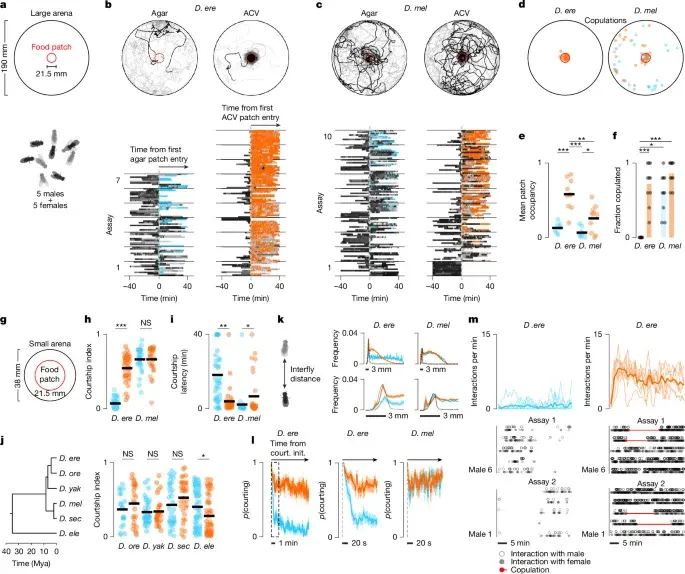
In Drosophila erecta, mating is strictly contingent on ecological cues, specifically food volatiles, which act as a sensory gate for sexual arousal. These odors trigger males to pursue mates, increasing visual motion that further amplifies arousal through a multisensory feedback loop. This mechanism ensures courtship occurs only when reproductive opportunities are abundant, a trait less pronounced in Drosophila melanogaster.
Key points
- D. erecta males require food volatiles to initiate courtship, unlike D. melanogaster where such cues are dispensable.
- Food odors drive aggregation and sampling, creating visual motion that amplifies sexual arousal across the group.
- Species-specific differences in arousal thresholds stem from how olfactory input modulates conserved neural circuits.
- The study highlights that environmental cues, not just sexual signals, reorganize social landscapes to align mating with resource availability.
Background
Previous research established that Drosophila species vary in mating strategies based on their ecological niches. While D. melanogaster mates on decaying substrates, D. erecta relies on seasonal host fruit availability. This study builds on those foundations by detailing the neural mechanisms that link environmental context to reproductive behavior in D. erecta.
Why it matters
Understanding how environmental cues gate sexual arousal provides insights into how animals adapt reproductive strategies to ecological constraints. It reveals that social behavior is not isolated but deeply integrated with the physical environment, offering a model for studying the neural basis of context-dependent decision-making in other species.
What to watch
Future research may explore how these neural mechanisms evolve across other Drosophila species with different ecological niches. Additionally, investigating the specific neural nodes that modulate olfactory input could help explain the rapid tuning of sensory thresholds in response to environmental changes.
Want the full story? Read the original reporting
Read on Nature