
Gaia BH1 Confirmed as Nearest Black Hole to Earth at 1,600 Light-Years
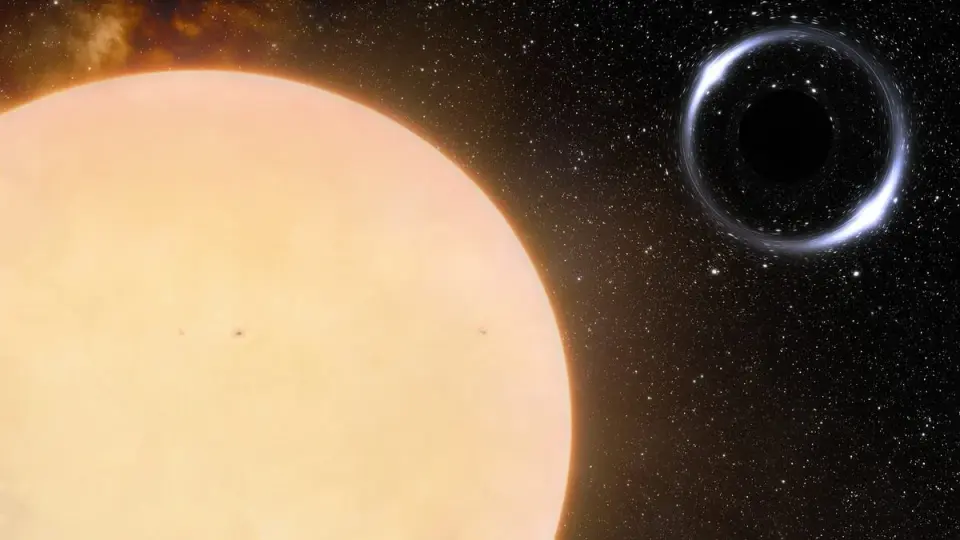
A stellar-mass black hole designated Gaia BH1, located approximately 1,600 light-years from Earth, has been confirmed as the closest known black hole to our planet. The discovery, announced in 2022, utilized data from ESA’s Gaia spacecraft alongside ground-based telescopes in Chile and Hawaii. The black hole has a mass ten times that of the Sun and orbits a Sun-like companion star. The wide separation between the two objects presents a significant challenge to standard models of binary star evolution, raising questions about how the companion survived the progenitor star's hypergiant phase.
Key points
- Gaia BH1 is the closest known black hole to Earth, situated at a distance of 1,600 light-years.
- The object is a stellar-mass black hole with a mass approximately ten times that of the Sun.
- Its discovery was announced in 2022, utilizing data from the Gaia spacecraft, the Magellan Baade telescope, and the Gemini Multi-Object Spectrograph.
- The black hole was detected by observing the unusual orbital motion of its Sun-like companion star.
- The wide orbital separation between the black hole and its companion is comparable to the distance between Earth and the Sun.
- The system's configuration does not easily fit standard binary evolution models, suggesting unique formation mechanisms.
Background
Recent astronomical surveys have focused on understanding black hole formation and evolution across cosmic history. For instance, earlier reports detailed the discovery of dual supermassive black holes in the early universe using the James Webb Space Telescope, as well as the identification of 'black hole stars' fueled by black hole energy. Additionally, studies of the Milky Way's central supermassive black hole, Sagittarius A*, have revealed the survival of water and dust near the galactic center. In contrast, Gaia BH1 represents a nearby, stellar-mass object, providing a local laboratory for studying black hole dynamics and binary evolution within our own galaxy.
Why it matters
Identifying the closest black hole to Earth provides a critical benchmark for understanding stellar-mass black hole formation and binary evolution. The anomalous wide orbit of Gaia BH1 challenges existing astrophysical models, suggesting that current theories may not fully account for the survival of companion stars near collapsing massive stars. This discovery enhances our ability to detect and characterize black holes in the Milky Way, potentially leading to new insights into how such systems form and evolve over time.
What to watch
Astronomers will continue to analyze Gaia BH1 to determine the specific mechanisms that allowed the companion star to survive the black hole's formation. Further observations may reveal additional nearby black holes, helping to refine models of stellar evolution and binary system dynamics. The findings may also inform future studies of black hole interactions and their role in the broader galactic ecosystem.
Want the full story? Read the original reporting
Read on BBC Sky at Night Magazine