
Ganymede: The Moon That Defies Planetary Definitions
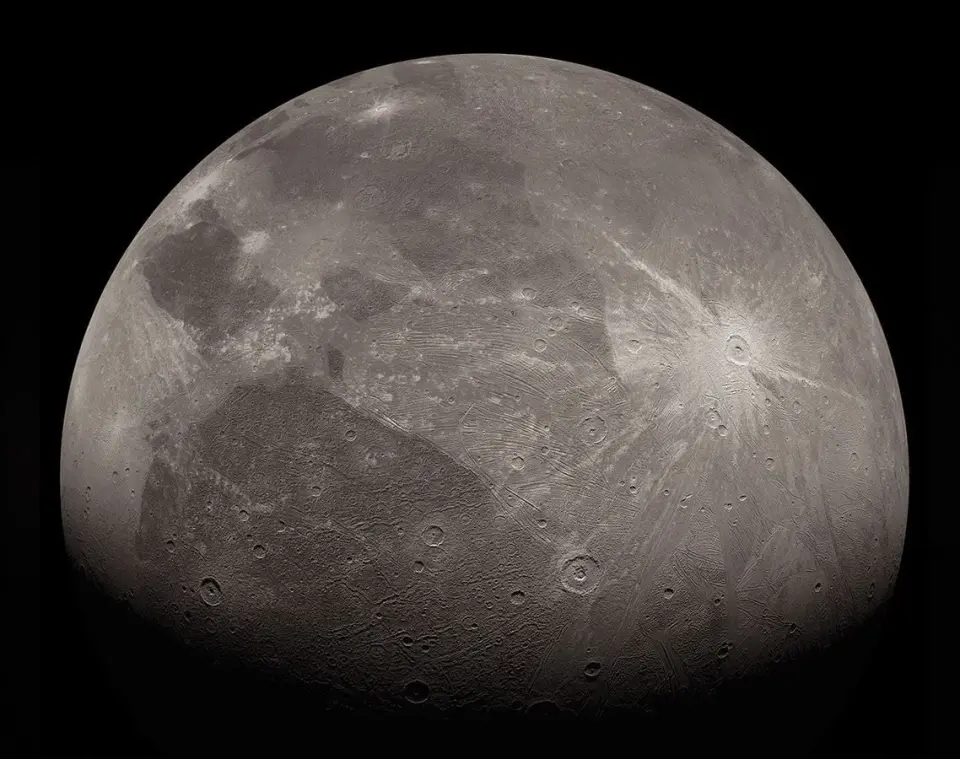
Jupiter's largest moon, Ganymede, possesses a diameter exceeding that of Mercury, a differentiated internal structure, and its own magnetic field, challenging traditional distinctions between moons and planets. While it orbits Jupiter rather than the Sun, its physical complexity suggests it functions as a full-sized world. Upcoming ESA missions aim to investigate its subsurface oceans and magnetic dynamo, which may hold more water than Earth's surface.
Key points
- Ganymede has a mean radius of 2,631.2 km, making it approximately 8% wider than Mercury, though it possesses only 45% of Mercury's mass due to lower density.
- The moon features a differentiated interior with an iron-rich core, rocky mantle, and extensive water-ice layers, similar to terrestrial planets.
- Ganymede generates its own intrinsic magnetic field via a core dynamo, a trait unique among Solar System moons, detected by NASA's Galileo spacecraft in 1996.
- Indirect evidence, including auroral measurements, suggests a subsurface salty ocean roughly 100 km thick beneath 150 km of ice, potentially containing more water than Earth's surface.
- ESA's JUICE mission, launched in 2023, is scheduled to orbit Ganymede in December 2034 to study its geology, magnetic field, and internal structure in detail.
Background
Previous coverage highlighted Saturn's Titan as another moon larger than Mercury, emphasizing that orbital classification does not equate to physical complexity. Additionally, recent studies on Jupiter's early history suggest the planet was significantly larger and had a much stronger magnetic field in the solar system's infancy, providing context for the dynamic environment in which Ganymede evolved.
Why it matters
Ganymede's characteristics challenge the binary classification of celestial bodies as either planets or moons, highlighting that orbital position does not dictate geological complexity. Understanding its subsurface oceans and magnetic field is crucial for assessing potential habitability and refining models of planetary formation. The upcoming JUICE mission will provide the first detailed orbital data, potentially reshaping our understanding of icy worlds in the outer Solar System.
What to watch
ESA's JUICE spacecraft is expected to arrive at Jupiter in July 2031 and enter orbit around Ganymede in December 2034. The mission will use radar, magnetic sensors, and laser altimetry to map the moon's ice shell, subsurface oceans, and magnetic field, aiming to determine how the moon maintains its dynamo and how its internal structure evolved.
Want the full story? Read the original reporting
Read on Space Daily