
Hubble’s Propellant-Free Steering: How Reaction Wheels and Magnetic Bars Keep the Telescope Pointing
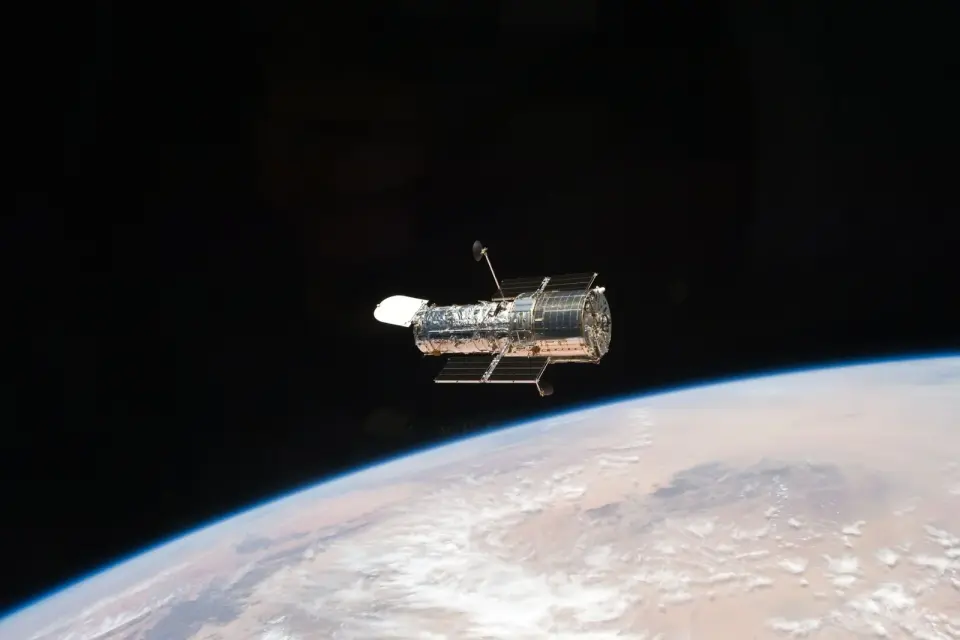
NASA’s Hubble Space Telescope changes orientation without firing thrusters, using internal reaction wheels to rotate the spacecraft and magnetic bars to exchange momentum with Earth’s field, a propellant-free system in use since 1990.
Key points
- Hubble lacks thrusters for attitude control to prevent exhaust contamination of its optical instruments.
- Four reaction wheels, each weighing about 45 kilograms, spin to rotate the 12-tonne observatory via conservation of angular momentum.
- Magnetic torquer bars interact with Earth’s magnetic field to bleed off accumulated momentum from the wheels, preventing saturation.
- A 90-degree turn takes approximately 14 minutes, with a slew limit of about six degrees per minute to ensure precise targeting.
- This system eliminates propellant limits but does not provide orbital boost, as Hubble still relies on external reboosts during servicing missions.
Background
Hubble has operated since 1990, with its pointing system relying on reaction wheels and magnetic torquers. Previous servicing missions, including STS-125 in 2009, maintained the telescope, while earlier issues with gyroscopes highlighted the distinction between sensing and actuating components in its control system.
Why it matters
The propellant-free steering system demonstrates a durable engineering solution for long-duration space missions, avoiding the finite fuel constraints and contamination risks associated with thrusters, ensuring Hubble’s continued precision for scientific observations.
What to watch
Hubble’s pointing system remains dependent on the mechanical integrity of its reaction wheels and sensors, with NASA maintaining contingency plans for reduced wheel operations if components fail, though no new developments are reported in the source.
Want the full story? Read the original reporting
Read on Space Daily